
What SMEDAN’s New MSME Financing Push Could Mean for Small Businesses in Nigeria
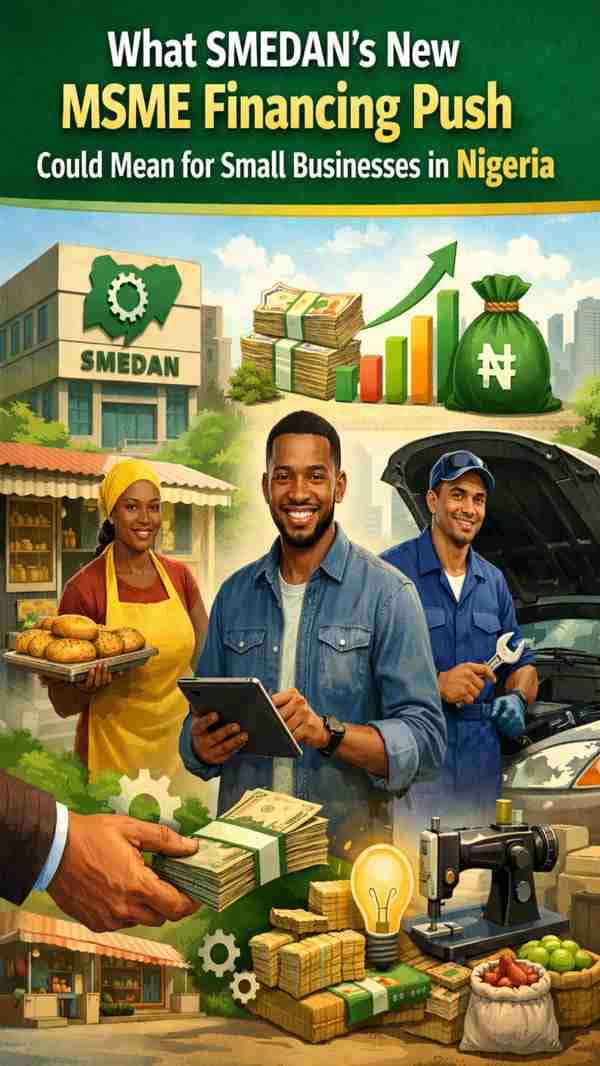
For millions of Nigerians, running a small business is not a “startup dream” it is survival.
From the woman selling provisions in a busy street to a tailor, food processor or the online vendor navigating Instagram algorithms, small businesses are the backbone of Nigeria’s economy.
Yet, despite their importance, access to funding remains one of the biggest struggles facing Micro, Small, and Medium Enterprises (MSMEs) in Nigeria.
This is why recent signals around SMEDAN’s renewed push for MSME financing and formalisation in 2026 are drawing attention across the business and policy space. While this is not a breaking news announcement, it represents a broader shift in how Nigeria is thinking about small business growth, one that deserves closer examination.
So what exactly does SMEDAN’s financing push mean? And more importantly, will it actually make life easier for small business owners on the ground?
Understanding SMEDAN’s Role in Nigeria’s MSME Ecosystem
The Small and Medium Enterprises Development Agency of Nigeria (SMEDAN) was created to support, coordinate, and promote the development of MSMEs across the country. On paper, its mandate is powerful: capacity building, access to finance, market linkage, and business formalisation.
In reality, many Nigerian entrepreneurs have either never interacted with SMEDAN or only hear about it during government programme announcements.
This gap between policy intention and everyday business reality is part of the challenge SMEDAN now appears determined to address.
With MSMEs accounting for over 90% of businesses in Nigeria and a significant share of employment, the government’s renewed attention to this sector is not accidental. High unemployment, inflation pressures, and declining purchasing power have made MSMEs more important than ever.
Why MSME Financing Has Become a Bigger Conversation in 2026
The timing of this renewed financing focus matters.
Nigeria’s business environment has changed dramatically over the last few years. Interest rates are higher. Bank lending has become more cautious. Many fintech lenders that once provided easy credit have tightened their requirements or raised their costs.
For small business owners, this has translated into a harsh reality:
You need money to grow, but money has become harder, and more expensive, to access.
At the same time, the government is under pressure to stimulate economic activity without relying solely on large corporations or oil revenues. MSMEs naturally sit at the center of this conversation.
SMEDAN’s financing push is therefore less about generosity and more about economic necessity.
What SMEDAN’s New Financing Push Is Really About
Rather than direct cash handouts, the current SMEDAN approach signals a multi-layered strategy. The focus is on improving access to funding by working with financial institutions, development partners, and state governments.
A key part of this strategy is formalisation, encouraging small businesses to register, keep records, and operate within structured systems. From a policy perspective, this makes it easier to track impact, reduce risk, and justify funding.
From the business owner’s perspective, however, formalisation can feel intimidating.
Many Nigerian entrepreneurs operate informally not because they want to evade regulation, but because:
• Registration feels complex
• Taxes feel unpredictable
• Documentation feels unnecessary for survival
SMEDAN’s challenge is to make formalisation feel like an opportunity, not a punishment.
The Real Funding Problem Nigerian MSMEs Face
When people talk about “access to finance,” they often imagine large loan amounts. But for many Nigerian MSMEs, the problem is far more basic.
A small trader might need ₦300,000 to restock.
A manufacturer might need ₦2 million for equipment repairs.
An online business might need working capital to manage logistics delays.
Traditional banks often see these needs as too small or too risky. When loans are offered, interest rates and collateral requirements push many business owners away.
This is where SMEDAN’s financing push could matter, if it is structured around real business needs, not abstract policy targets.
What This Could Mean for Informal Businesses
One of the most significant implications of SMEDAN’s renewed focus is its potential impact on Nigeria’s vast informal sector.
Millions of businesses operate outside formal systems, yet they contribute massively to local economies. Bringing them into structured financing frameworks could unlock growth,but only if done carefully.
If SMEDAN succeeds in simplifying registration, improving awareness, and partnering with lenders that understand MSME realities, informal businesses could finally access:
• Lower-cost financing
• Business training and advisory support
• Market opportunities beyond local communities
However, if formalisation is pushed without support, it risks excluding the very businesses the programme is meant to help.
The Human Side of MSME Financing
Behind every MSME statistic is a real person.
There is the baker who wakes up at 4 a.m. to beat electricity outages.
The fashion designer whose biggest challenge is unstable demand.
The small exporter struggling with logistics costs and foreign exchange volatility.
Financing, for these entrepreneurs, is not just about growth, it is about stability.
A well-structured SMEDAN financing framework could help businesses move from survival mode to sustainability. But this requires empathy in policy design, not just numbers on a spreadsheet.
Lessons from Past MSME Funding Initiatives
Nigeria has seen several MSME-focused funding initiatives over the years. Some have made impact; many have faded quietly.
Common challenges include:
• Poor awareness at the grassroots
• Complex application processes
• Political interference
• Weak monitoring and follow-up
For SMEDAN’s current push to succeed, it must learn from these lessons. Accessibility, transparency, and consistency will matter more than ambitious targets.
The Role of Partnerships in Making This Work
SMEDAN cannot do this alone.
Banks, microfinance institutions, fintech lenders, development agencies, and state governments all have roles to play. Effective partnerships can help reduce risk, lower borrowing costs, and tailor financing to specific sectors.
For example, agribusinesses, creative enterprises, and manufacturing MSMEs all have different funding needs. A one-size-fits-all financing model rarely works.
The success of this push will depend on how well SMEDAN coordinates these partnerships and aligns incentives.
What Small Business Owners Should Pay Attention To
For Nigerian MSMEs, the key is not to wait passively.
Business owners should pay attention to:
• SMEDAN registration opportunities
• State-level MSME programmes
• Partnerships between SMEDAN and financial institutions
• Training and capacity-building initiatives tied to funding
Preparation matters. Businesses with basic records, clear operations, and defined needs are more likely to benefit when financing opportunities arise.
Why This Matters for Nigeria’s Broader Economy
Beyond individual businesses, SMEDAN’s financing push has wider implications.
Strong MSMEs mean:
• More employment
• More local production
• Reduced dependence on imports
• Broader tax base over time
In an economy facing structural challenges, MSMEs offer resilience. Supporting them is not charity, it is smart economic policy.
Final Thoughts: Opportunity or Another Missed Chance?
SMEDAN’s renewed focus on MSME financing comes at a critical moment for Nigeria. The intention is promising, and the economic logic is sound.
But intention alone is not enough.
The real test will be whether small business owners not just policymakers,feel the impact. If financing becomes more accessible, processes become simpler, and support becomes more human, this push could mark a turning point.
If not, it risks becoming another well-meaning initiative that never truly reaches the streets where Nigerian businesses live and breathe.
For now, the opportunity is there. What happens next will define how seriously Nigeria supports its small businesses in 2026 and beyond.
Keep reading
Related Topics





Conversation
Comments (0)
Sign in to join the conversation or like this post.