
10 Common Mistakes Small Business Owners Make (And How to Avoid Them)

Starting a business is exciting. Running one? That’s where reality sets in.
Nigeria has one of the most vibrant small business cultures in Africa. From the trader at Balogun market to the fintech founder bootstrapping her app idea on a laptop and generator power. Nigerians build businesses everywhere, in every condition, against every odd.
But here’s the uncomfortable truth: most small businesses in Nigeria don’t survive their fifth year. Not because Nigerians aren’t hardworking or creative. But because many business owners repeat the same avoidable mistakes, over and over, until the business can’t absorb them anymore.
A lot of small businesses don’t fail because their ideas are bad. They fail because of quiet, internal habits that drain cash, stall growth, and turn promising ventures into “what could have been.”
Your business is not just your hustle. It’s a system, and systems require structure, not just sweat.
Here are ten mistakes quietly killing Nigerian small businesses, and how to avoid every single one.
1. Mixing Personal and Business Money
The most common one amongst all. You receive payment from a customer and use it to buy groceries. You “borrow” from the business account to pay rent. It feels harmless, especially early on but it slowly bleeds your business dry without you even noticing.
When your money lives in one place, you can’t track profit accurately, you can’t spot where cash is leaking, and you can’t plan for growth. When the business finally needs reinvestment, there’s nothing left. Being busy is not the same as being profitable.
FIX IT - Open a dedicated business account today, even a basic one. Pay yourself a fixed salary from it. Whatever remains is the business’s money. Full stop.
2. Ignoring Cash Flow
The most critical one. Here’s something many business owners don’t realise until it’s too late: a business can be profitable on paper and still go broke. Profit is what the numbers say. Cash flow is what keeps the lights on.
Customers delay payments. Inventory ties up capital. Expenses hit before revenue arrives. You could have ₦5 million in outstanding invoices and still be unable to pay rent this month. This is how thriving-looking businesses suddenly collapse.
FIX IT - Track your cash flow weekly, not monthly. Know what’s coming in and when. If money isn’t moving in when you need it, you have a problem, no matter how healthy your “profit” looks on paper.
3. Underpricing Products and Services
The underrated issue. Many Nigerian entrepreneurs underprice out of fear (fear of losing customers, fear of competition, fear of being “too expensive”). So they cut margins until the business isn’t really profitable. It’s just busy.
Your price must cover your cost of goods, your time, your overhead (rent, data, fuel, transport), and a real profit margin. If it doesn’t, you’re quietly subsidising your customers’ lives with your own energy. That is not a business model, it’s a countdown.
FIX IT - Do a proper cost analysis. Calculate your total cost per unit or service, then add your margin deliberately. If a customer won’t pay a sustainable price, they may simply not be your customer.
4. No Business Plan or No Plan at All
Running a business without a plan is like driving without a destination. You’ll move, you’ll stay busy, but you won’t necessarily get anywhere useful. A business plan doesn’t need to be a 40-page document, but having zero plan means zero roadmap when things get hard.
In Nigeria’s economic environment, where inflation erodes purchasing power and customers are increasingly price-sensitive, decisions made under pressure without a plan are almost always the wrong ones.
FIX IT - Write a simple one-pager. Who is your customer? What problem do you solve? What’s your revenue model? How will you reach people? It doesn’t need to be fancy. It just needs to exist.
5. No Bookkeeping or Financial Records
If you ask many small business owners how much they made last month, they’ll say “it’s been moving” or estimate from memory. “Everything is in my head” is not bookkeeping.
Without records, you can’t track performance, can’t apply for loans or grants, can’t file accurate taxes, and can’t make informed decisions. Beyond compliance, good records reveal patterns: which products move fastest, which months are slow, which clients pay on time. That information is genuinely valuable.
FIX IT - Start with a simple Excel sheet. Track income and expenses consistently. Free tools like Wave Accounting work perfectly for early-stage businesses. Upgrade as you grow, but start now.
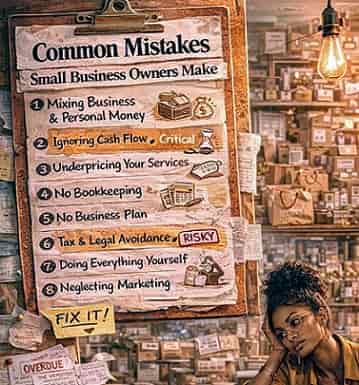
6. Neglecting Legal and Tax Compliance
A risky one. Many business owners avoid thinking about taxes, either because they don’t fully understand the system or because they assume “FIRS won’t come for me.” That gamble has an expiry date, especially if you ever want to scale, access loans, or win contracts requiring tax clearance certificates.
Under Nigerian law, businesses must register with the Corporate Affairs Commission (CAC), obtain a Tax Identification Number (TIN), and file returns. Ignoring this doesn’t make the obligation disappear. It just makes the penalties larger when reality arrives.
FIX IT - Register your business, get your TIN, and engage a small-business accountant for at least quarterly reviews. The cost of proper compliance is far cheaper than the cost of penalties, or losing a major contract.
7. Doing Everything Alone
Nigerian hustle culture celebrates the solo grinder who handles everything themselves. But refusing to delegate creates a business that can only grow as large as one person’s capacity. If your business collapses the moment you take a week off, you don’t own a business, you've built a stressful job with no annual leave.
This also applies to skills you simply don’t have. Trying to manage your own accounting without understanding it, or designing your own branding when that’s not your strength, usually costs more in mistakes than just paying someone would have.
FIX IT - Identify your highest-value tasks and protect that time. Delegate or outsource the rest (freelancers, interns, part-timers). Build systems so the business doesn’t depend entirely on you showing up every day.
8. Neglecting Marketing
The one that’s often overlooked. Some business owners build genuinely great products, and then wait for customers to show up. They won’t. Great products don’t sell themselves, especially in a crowded, competitive market.
In today’s landscape, consistent visibility is not optional, it’s survival. Social media presence, word-of-mouth strategies, content marketing, simple advertising, these are not extras. They are how people find out you exist. If they don’t know you exist, they can’t buy from you.
FIX IT - Build a simple, consistent marketing plan that matches your goals and your budget. Even showing up regularly on one social platform and actively asking for referrals is a strategy. Do something intentional.
9. No Emergency Fund or Business Buffer
Another critical one. Nigeria’s business environment is unpredictable by design. The naira depreciates. NEPA takes light for days. A key supplier disappears. A major client delays payment for months. These are not hypotheticals, they are regular realities every Nigerian business owner faces.
Most small business owners reinvest everything or spend profits immediately. Without a cash buffer, you’re one bad month away from borrowing at punishing interest rates, selling assets, or shutting down entirely.
FIX IT - Aim to hold at least 2–3 months of operating expenses in a separate account. Build it slowly, even setting aside 5% of monthly revenue is a meaningful start. Protect it like it’s someone else’s money.
10. Neglecting Customers, and Quitting Too Soon
Two final mistakes that often go hand in hand.
First: In the chase for new customers, many business owners forget to care for the ones they already have. Word-of-mouth is one of the most powerful marketing channels available, and it works both ways. A loyal customer can become your best advocate. A neglected one becomes a public warning.
Second: many businesses fail not because they couldn’t work, but because the owner quit before finding their footing. Every business hits rough patches. Persistence, combined with the willingness to learn and adapt is often the actual difference between failure and success.
FIX IT - Follow up after sales. Ask for feedback. Appreciate loyalty. And when business is hard, diagnose before you quit, figure out what specifically isn’t working, fix it, and keep going.
Bottom Line
Mistakes are normal. Repeating them isn't.
Running a small business in Nigeria takes real guts. Between inflation, unstable infrastructure, tight consumer wallets, and a market that doesn’t forgive carelessness, the environment is genuinely demanding. But the truth is that most business failures aren’t caused by external forces alone, they’re made worse by internal habits that could actually be changed.
The smartest business owners aren’t the ones who avoid every mistake. They’re the ones who spot mistakes early, fix them quickly, and build stronger systems as a result. That’s the real skill.
Pick the one mistake on this list that resonates most with where you are right now. Make one adjustment this week. Then the next. Your future self, and your future profit margins will thank you.
Keep reading
Related Topics






Conversation
Comments (0)
Sign in to join the conversation or like this post.

Elizabeth Ayoola
Elizabeth is a finance analyst and writer passionate about making financial markets accessible to everyday readers.
She has a deep interest in global markets, crypto, and everything shaping the financial world. She writes to simplify complex financial topics, turning them into practical, accessible insights for everyday readers.
102
Stories
31703
Reads
1
Likes
0
Comments