
Understanding BOI, NIRSAL & Other Government Funding in 2026: Eligibility and How to Qualify
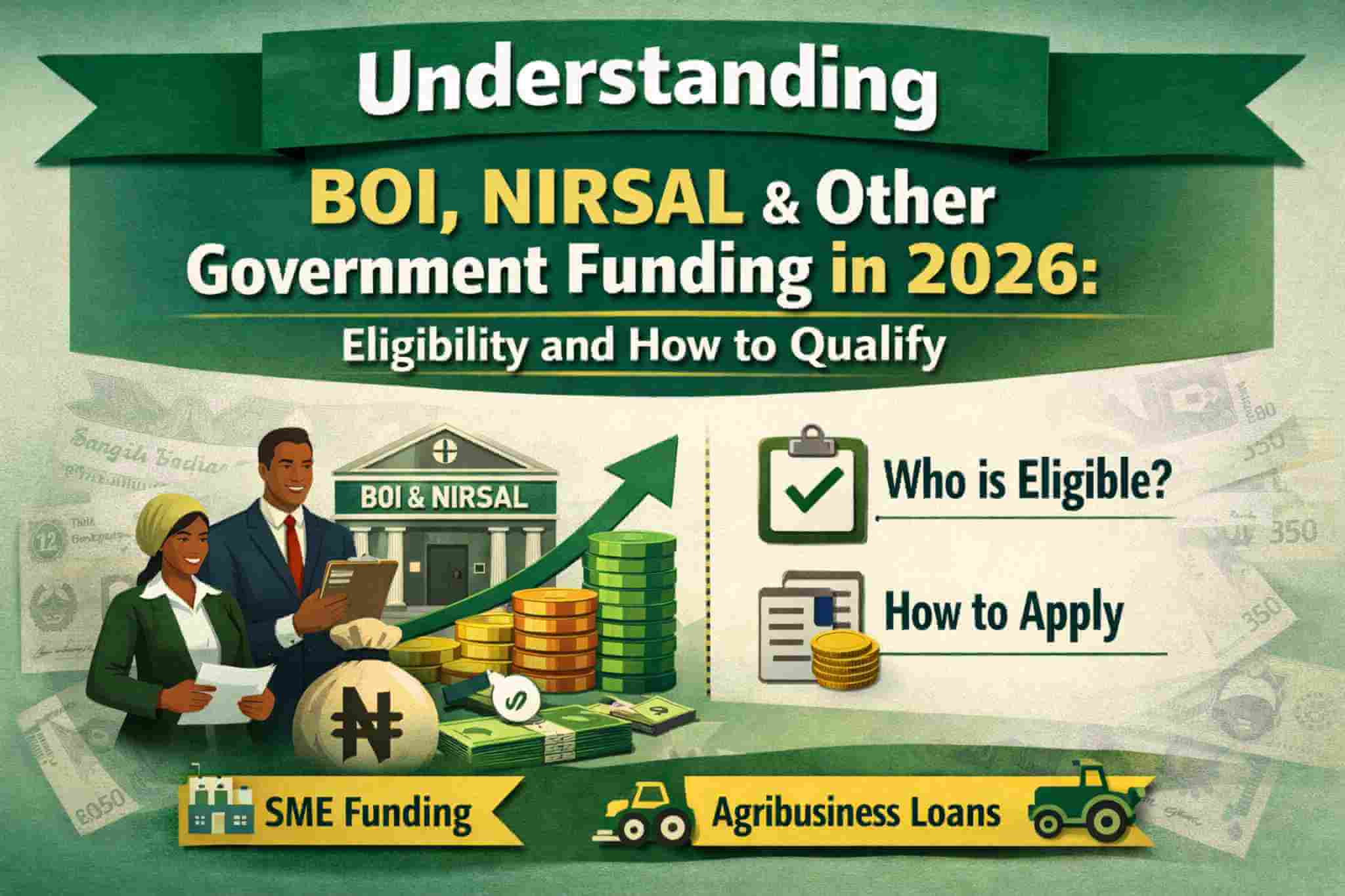
For many Nigerian entrepreneurs, access to funding remains one of the biggest obstacles to starting or growing a business. Ideas are everywhere, but capital is not. Banks often require strong collateral, high interest payments, and long credit histories that many small business owners simply do not have.
Because of this gap, government-backed funding programs have become increasingly important. Over the years, institutions like the Bank of Industry (BOI) and NIRSAL have introduced financing schemes designed to support small businesses, agriculture, manufacturing, and youth-led enterprises. Yet despite these opportunities, many Nigerians still struggle to access them.
The problem is not always the absence of funding. Often, it is a lack of understanding about how these programs actually work, who qualifies, and what government agencies are truly looking for.
In 2026, government intervention funding remains one of the most affordable sources of business finance available in Nigeria, but accessing it requires preparation, patience, and the right information.
Why Government Funding Exists
Government funding programs are created to solve a specific economic problem. Traditional banks naturally avoid high-risk borrowers, especially small businesses without long financial records. While this protects banks, it leaves many promising entrepreneurs without support.
To close this gap, the government provides financing through development institutions. These funds are usually targeted at sectors considered important for national growth, such as agriculture, manufacturing, technology, renewable energy, and small and medium-sized enterprises.
Unlike commercial loans, these programs often come with lower interest rates, longer repayment periods, and sometimes grace periods before repayment begins. The goal is not just profit but economic development,job creation, local production, and reduced dependence on imports.
However, lower interest does not mean easier approval. In fact, many applicants are rejected because they misunderstand how structured these programs are.
Understanding the Bank of Industry (BOI)
The Bank of Industry is Nigeria’s primary development finance institution focused on supporting businesses that can contribute to economic growth. BOI funding is not designed for casual business ideas or informal trading alone. The institution prioritizes businesses that show structure, scalability, and the ability to create employment.
In recent years, BOI has supported sectors such as agro-processing, fashion manufacturing, food production, creative industries, and small-scale manufacturing. Many of its programs are also aligned with youth entrepreneurship and women-led businesses.
One common misconception is that BOI gives out grants. In reality, most BOI funding comes as loans but at significantly lower interest rates compared to commercial banks.
Eligibility usually depends on several factors. Applicants must have a registered business, a clear business plan, and verifiable operations or a strong implementation strategy. BOI wants to see that the business solves a real market problem and has realistic financial projections.
What matters most is proof that the business can repay the loan while growing sustainably.
What NIRSAL Does Differently
NIRSAL, which stands for the Nigeria Incentive-Based Risk Sharing System for Agricultural Lending, focuses mainly on agriculture and agribusiness financing.
Agriculture has historically been considered risky by banks because of factors like weather conditions, logistics challenges, and price fluctuations. NIRSAL was created to reduce this risk by providing guarantees and technical support that encourage lenders to finance agricultural businesses.
In 2026, NIRSAL continues to play a major role in supporting farmers, food processors, livestock businesses, and agricultural value chains. But funding through NIRSAL is not limited to farming alone. Businesses involved in storage, transportation, packaging, and processing also qualify because they contribute to the agricultural ecosystem.
Unlike traditional loans, NIRSAL often combines financing with training and monitoring. Applicants are expected to demonstrate knowledge of their sector and show operational readiness.
This means passion alone is not enough. Applicants must understand production costs, supply chains, and market demand.
Other Government Funding Opportunities in 2026
Beyond BOI and NIRSAL, several government-backed initiatives continue to provide financing opportunities through partnerships with ministries, financial institutions, and development agencies.
Youth-focused programs often target innovation, digital entrepreneurship, and small enterprise growth. Some schemes operate through state governments, while others are coordinated nationally to support specific industries.
Many of these programs are periodically relaunched or redesigned depending on economic priorities. For example, during periods of high unemployment, funding may focus more on youth enterprises. During food supply challenges, agriculture receives stronger attention.
Because of this, entrepreneurs who stay informed and prepared often benefit more than those who wait until announcements are made before preparing applications.
Why Many Applicants Fail
One of the biggest reasons people fail to access government funding is misunderstanding what these institutions are looking for.
Many applicants approach funding as if it were financial assistance rather than investment support. Applications are sometimes submitted without proper documentation, realistic financial projections, or clear operational plans.
Government funding agencies evaluate risk just like banks do,sometimes even more carefully because they manage public funds.
Another common mistake is applying without an existing structure. Even small businesses are expected to show some level of organization, whether through record keeping, customer history, or operational evidence.
The strongest applications usually come from entrepreneurs who treat their businesses professionally before seeking funding.
What Eligibility Really Means
Eligibility is not only about meeting listed requirements. It is about demonstrating readiness.
A registered business name or company is usually the starting point, but it is not enough on its own. Applicants must show financial discipline, a clear revenue model, and understanding of their industry.
Lenders also look for commitment. Entrepreneurs who have invested time, effort, or personal resources into their business often appear more credible than those starting entirely from scratch.
Credit history, where available, can also influence decisions. Even small financial responsibilities handled responsibly help build trust.
How to Improve Your Chances of Approval
Qualifying for government funding is less about luck and more about preparation.
Businesses that succeed usually have detailed business plans written in simple, realistic language. They understand their costs, expected income, and potential risks. They can clearly explain how the funding will be used and how repayment will happen.
Proper financial records also make a major difference. Even small businesses benefit from tracking sales, expenses, and profit consistently. This shows seriousness and transparency.
Entrepreneurs should also pay attention to industry alignment. Funding programs are designed around economic priorities, so applications that clearly match those priorities stand a better chance.
Most importantly, patience is necessary. Approval processes can take time because applications pass through multiple review stages.
The Bigger Picture: Why Government Funding Matters in 2026
Nigeria’s economic environment continues to push entrepreneurship as a major driver of growth. With unemployment pressures and rising business costs, government-backed financing remains a critical tool for supporting enterprise development.
These programs are not perfect, and access can sometimes feel slow or competitive. But they represent an important alternative to high-interest commercial loans.
For many successful Nigerian businesses today, early-stage support came from development finance programs that allowed them to grow gradually without overwhelming debt.
Understanding how these systems work gives entrepreneurs an advantage. Instead of seeing funding as an opportunity that appears randomly, they can prepare strategically and apply when the right program opens.
Final Thoughts
Government funding through BOI, NIRSAL, and related initiatives is not free money, nor is it impossible to access. It sits somewhere in between structured support designed for entrepreneurs who are serious about building sustainable businesses.
In 2026, the entrepreneurs most likely to benefit are those who understand that qualification begins long before an application form is filled. It starts with building structure, maintaining records, understanding the market, and presenting a clear vision.
Funding agencies are not only looking for businesses that need money. They are looking for businesses that are ready to grow responsibly.
For entrepreneurs willing to prepare properly, government financing can move from being a distant opportunity to a practical stepping stone toward long-term business success.
Keep reading
Related Topics




Conversation
Comments (0)
Sign in to join the conversation or like this post.