
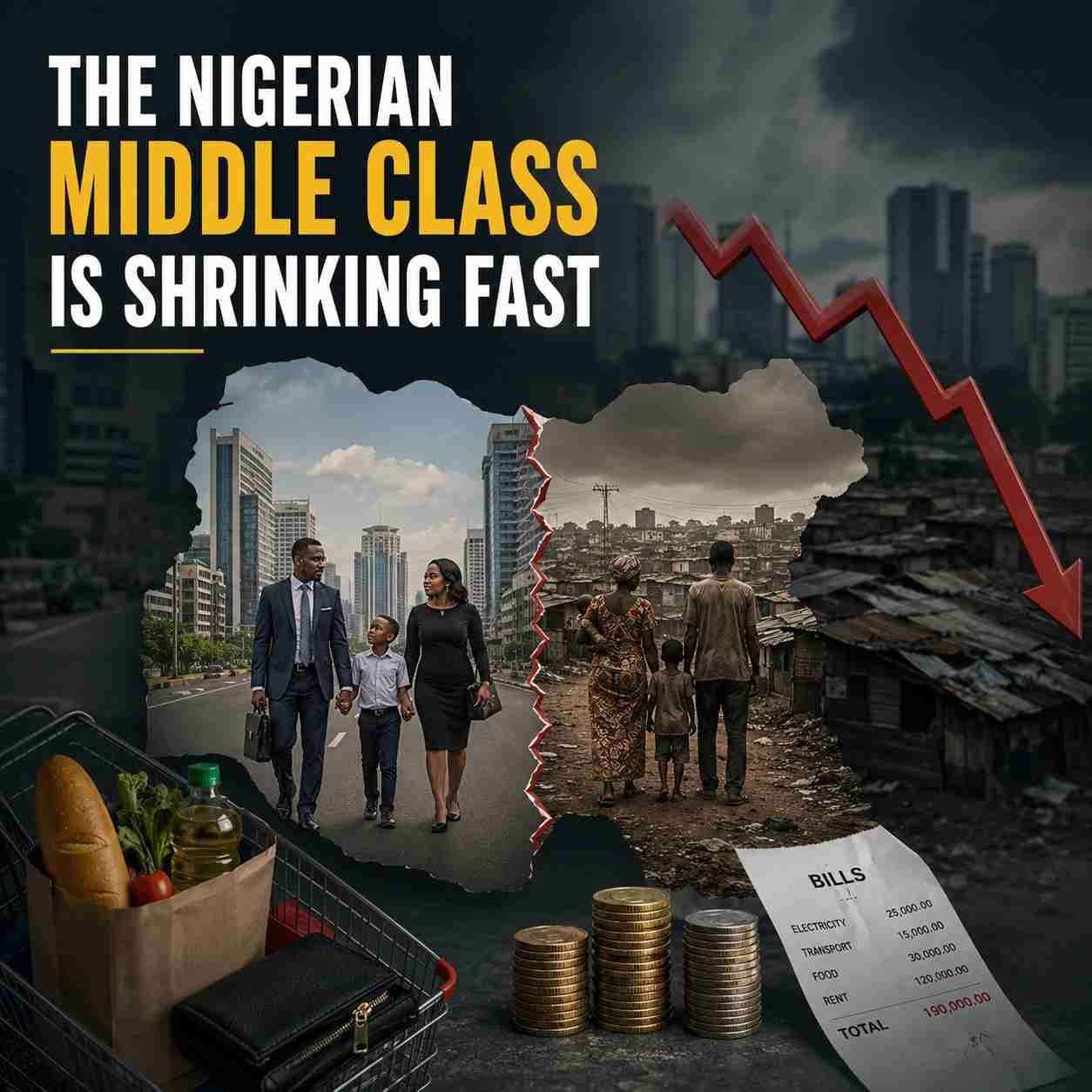
For years, being middle class in Nigeria meant living a relatively comfortable life.You could pay your rent without too much stress. You could afford decent healthcare. Your children could attend a good school. You might own a car, take occasional trips, and still have some money left for savings or investments.
You were not rich, but you were doing better than most. Today, that reality is becoming increasingly difficult to maintain.
Across Nigeria, many people who once considered themselves comfortably middle class are finding it harder to keep up with the rising cost of living. Expenses are growing faster than incomes, and households that previously enjoyed financial stability are now making difficult choices about spending, saving, and even basic necessities.
The Nigerian middle class is under pressure, and many experts believe it is shrinking.
Who Exactly Is the Middle Class?
The middle class is often described as the group of people between the wealthy and the poor.
In Nigeria, this group typically includes:
• Salaried professionals
• Small business owners
• Civil servants
• Teachers
• Bank workers
• Engineers
• Healthcare workers
• Mid-level managers
• Entrepreneurs with stable incomes
What defines the middle class is not necessarily how much money people earn but their ability to maintain a reasonable standard of living.Traditionally, middle-class families could:
• Afford decent housing
• Access quality education
• Pay medical bills
• Own household appliances
• Save for emergencies
• Invest for the future
The challenge today is that many families can still earn the same income they earned a few years ago but can no longer afford the same lifestyle.
Why the Middle Class Is Shrinking
Several economic factors have combined to place enormous pressure on Nigerian households
1.Inflation Has Reduced Purchasing Power
One of the biggest reasons is inflation.Simply put, the prices of goods and services have risen significantly.
Food, transportation, rent, electricity, school fees, healthcare, and other everyday expenses have become much more expensive.
Many workers have received salary increases over the years, but those increases have often failed to match the pace of rising prices.As a result, many families are finding that their income buys less than it used to.
Someone who felt financially comfortable three years ago may now be struggling to maintain the same standard of living.
2.Food Prices Are Consuming More Household Income
Perhaps nowhere is the pressure more visible than in food expenses.Many Nigerian households have seen their grocery bills rise dramatically over the past few years.Items that families once purchased routinely now require more careful budgeting.
People are increasingly:
• Buying smaller quantities
• Switching to cheaper alternatives
• Cutting back on non-essential items
• Reducing eating out
For many middle-class families, food now takes up a much larger share of monthly income than it did previously.
3.Housing Is Becoming More Expensive
Rent has become another major challenge. In many cities, tenants have faced significant increases in rental costs.
Landlords are adjusting prices to reflect rising construction costs, inflation, and broader economic conditions.
For families whose income has not increased proportionately, housing expenses now consume a larger percentage of earnings.
This has forced some households to:
• Move to cheaper neighborhoods
• Downsize their homes
• Delay plans to buy property
For many people, housing is no longer just a financial obligation; it has become a source of constant anxiety.
4.Transportation Costs Have Increased
Transportation is another area where many households feel the impact.Workers who commute daily have experienced higher transportation expenses.
Business owners who move goods across the country face higher logistics costs.Parents transporting children to school are spending more.
These costs eventually affect almost every aspect of life because transportation influences the prices of goods and services throughout the economy.
5.Education Is Becoming Harder to Afford
One characteristic of middle-class families is the strong emphasis on education. Many parents are willing to make sacrifices to ensure their children receive quality schooling.
However, education costs continue to rise.School fees, books, transportation, uniforms, and extracurricular activities have become increasingly expensive.
Some parents are now reconsidering educational choices that previously seemed affordable.Others are postponing plans for international education or private schooling.The pressure on family finances continues to grow.
6.Healthcare Costs Are Rising
Healthcare has become another major concern. Middle-class families often rely on private healthcare facilities because of concerns about public healthcare services.Unfortunately, healthcare costs have increased significantly.
Medical consultations, diagnostic tests, medications, and treatments now place greater strain on household budgets. For families without comprehensive health insurance, a medical emergency can quickly become a financial crisis.
7. The Savings Problem
One of the clearest signs of a shrinking middle class is the decline in savings.
Traditionally, middle-class families saved money for:
• Emergencies
• Children’s education
• Home ownership
• Retirement
• Investments
Today, many households report that a larger portion of their income goes toward immediate needs.After paying for food, housing, transportation, education, and healthcare, there is often little left to save.
This creates financial vulnerability because families have fewer resources to handle unexpected expenses.
Why More Nigerians Are Taking Side Hustles
The growing popularity of side hustles is another indication of financial pressure. Many professionals now operate businesses outside their primary jobs. Some sell products online.Others offer consulting services.Some engage in freelancing, content creation, tutoring, or digital marketing.
While side hustles can be positive opportunities, their widespread growth also reflects a reality: many households are searching for additional income sources to maintain their lifestyle. A single salary is no longer sufficient for many families.
The Middle Class Is Working More but Feeling Less Secure
One of the most frustrating experiences for many Nigerians is that they are working just as hard or even harder than before.Yet they feel less financially secure.
A family earning a respectable income may still struggle with:
• Rising bills
• Unexpected expenses
• School fees
• Medical costs
• Rent increases
This creates a sense of financial uncertainty.People who once felt stable now worry about maintaining their standard of living.
Small Businesses Are Also Feeling the Pressure
The shrinking middle class does not affect only households.It also affects businesses.
Middle-class consumers are important customers for many industries.When household budgets become tighter, spending habits change.
People begin to:
• Delay purchases
• Buy fewer luxury items
• Reduce entertainment spending
• Postpone major expenses
Businesses that depend heavily on consumer spending often feel the impact. This creates a ripple effect throughout the economy.
The Rise of Survival Spending
Many economists describe a shift from discretionary spending to survival spending.
In simple terms, households are focusing more on necessities and less on wants.
People prioritize:
• Food
• Rent
• Transportation
• Healthcare
• Education
Meanwhile, spending on luxury goods, vacations, gadgets, and other non-essential items often declines. This shift changes consumer behavior and affects economic growth.
Can the Middle Class Recover?
Despite the challenges, many Nigerians remain resilient.Families continue to adapt.Entrepreneurs continue to create opportunities.Professionals continue to acquire new skills.
Technology has also created new income opportunities through:
• Remote work
• Digital businesses
• Online education
• E-commerce
• Content creation
Many households are finding creative ways to supplement income and improve financial stability. However, long-term recovery depends on broader economic improvements, stronger job creation, income growth, and a stable business environment.
What This Means for Young Nigerians
For younger Nigerians entering the workforce, the shrinking middle class presents important lessons.
The traditional formula of earning a salary and expecting gradual financial progress is becoming more challenging.
Many young professionals are increasingly focusing on:
• Multiple income streams
• Entrepreneurship
• Digital skills
• Investments
• Financial literacy
The goal is not merely to earn income but to build financial resilience.In today’s economy, adaptability has become one of the most valuable assets.
The Human Side of the Story
Behind every economic statistic is a real family.A parent deciding whether to change schools.A worker postponing plans to buy a home.A business owner struggling with rising costs.A graduate taking on multiple jobs to stay afloat.
The shrinking middle class is not just an economic story.It is a human story.It affects how people live, spend, save, and plan for the future.
Final Thoughts
Nigeria’s middle class has long been viewed as the backbone of economic growth and stability. However, rising living costs, inflation, housing expenses, transportation costs, healthcare bills, and educational expenses are placing increasing pressure on households.
Many families who once enjoyed financial comfort are now finding it harder to maintain the same standard of living. While resilience, innovation, and entrepreneurship continue to help many Nigerians adapt, the reality remains clear: the middle class is under strain.
The question is no longer whether households feel the pressure.The question is how they will continue adapting in an economy where maintaining a middle class lifestyle is becoming more challenging every year.
Keep reading
Related Topics



Conversation
Comments (0)
Sign in to join the conversation or like this post.

Maramercii
Maramercii contributes reporting and analysis for NaijUp, covering the stories, markets, and business trends shaping Nigeria.
67
Stories
35070
Reads
0
Likes
0
Comments