
NRS Begins Compliance Monitoring: Large Taxpayers Must Meet E-Invoicing Deadline by July 31, 2026
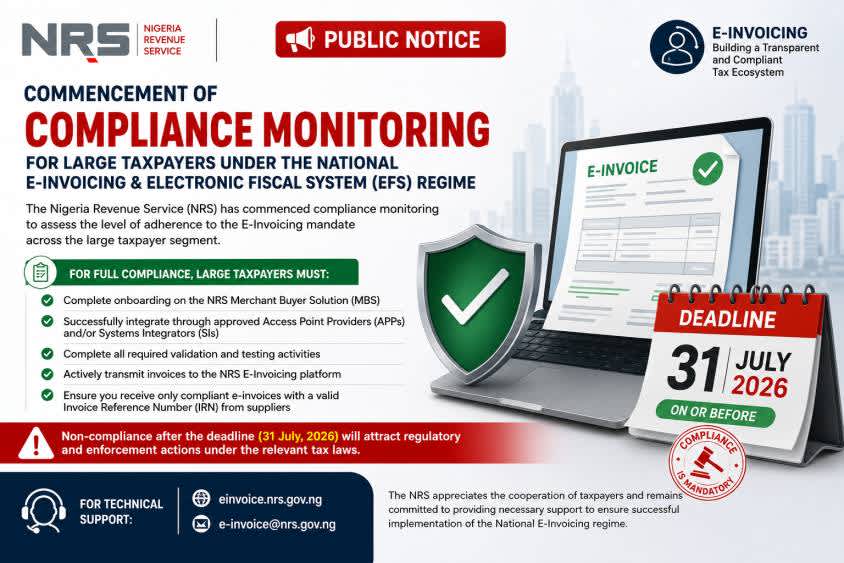
The Nigeria Revenue Service (NRS) has officially commenced compliance monitoring for large taxpayers under the National E-Invoicing & Electronic Fiscal System (EFS) Regime, marking a significant step in Nigeria's ongoing digital tax transformation.
The announcement serves as a final reminder to all affected businesses that non-compliance after the July 31, 2026 deadline will attract regulatory and enforcement actions under the relevant tax laws.
What Is the NRS E-Invoicing & EFS Regime?
The National E-Invoicing & Electronic Fiscal System (EFS), also known as the Merchant Buyer Solution (MBS), is designed to digitize invoice generation, validation, and reporting for tax purposes.
According to the public notice, all large taxpayers are expected to complete the following:
Register and onboard onto the NRS Merchant Buyer Solution (MBS).Successfully integrate their accounting or ERP systems using approved Access Point Providers (APPs) or Systems Integrators (SIs).Complete all required testing and validation processes.Begin active transmission of invoices to the NRS E-Invoicing platform.Ensure all supplier invoices carry a valid Invoice Reference Number (IRN).
Compliance Monitoring Has Started
The NRS confirmed that it has already begun monitoring compliance among large taxpayers to assess their level of adherence to the mandatory e-invoicing framework.
Businesses that have not yet started or completed implementation are advised to act immediately to avoid penalties.
Important Deadline: July 31, 2026
Large taxpayers must complete onboarding, integration, testing, and commence invoice transmission on or before July 31, 2026.
Failure to comply after the deadline will result in regulatory and enforcement actions in accordance with Nigeria's tax laws and regulations.
Why This Matters
The adoption of e-invoicing is expected to:
- Improve tax transparency.
- Reduce tax fraud and invoice manipulation.
- Enhance compliance and reporting accuracy.
- Speed up invoice verification and validation.
- Support Nigeria's digital economy and revenue collection initiatives.
For businesses, early compliance helps avoid operational disruptions, penalties, and last-minute implementation challenges.
What Large Taxpayers Should Do Now
If your organization falls under the large taxpayer category, now is the time to:
- Complete your NRS onboarding.
- Engage an approved integration partner if necessary.
- Test your invoicing systems.
- Start transmitting compliant electronic invoices.
- Verify that invoices received from suppliers include a valid Invoice Reference Number (IRN).
Delaying implementation could expose your business to regulatory sanctions once the compliance deadline passes.
Need Technical Support?
For enquiries and implementation support, contact the Nigeria Revenue Service through:
? Website: einvoice.nrs.gov.ng? Email: e-invoice@nrs.gov.ng
The commencement of compliance monitoring signals that the NRS is moving from awareness to enforcement. Large taxpayers should prioritize completing all implementation requirements well before July 31, 2026 to remain compliant and avoid regulatory actions.
Businesses that prepare early will be better positioned to transition smoothly into Nigeria's digital tax administration era.
Keep reading
Related Topics


Conversation
Comments (0)
Sign in to join the conversation or like this post.

Mujeeb Olagunju
I am a finance professional with a strong background in economics and financial technology.,My work centers on building systems that support payments, digital banking, and investment solutions in emerging markets.,I have experience with risk management, transaction monitoring, fraud prevention, and the design of scalable financial products tailored to both retail and institutional clients.,With over 8 years of industry experience, I combine financial insight with technical expertise to deliver solutions that balance compliance, security, and business growth.,My goal is to bridge the gap between finance and technology, creating platforms that expand access to modern financial services and strengthen trust in digital finance.
75
Stories
23094
Reads
0
Likes
0
Comments
Latest by Mujeeb Olagunju
Village Prices Fell in September, But Not Where It Counts: Transport and School Fees Shot Up
general
Imported Food Is Now Rising Half as Fast as Food Grown in Nigeria. Here's What the NBS Numbers Show
general
Clothing Prices Rose Just 1.08% in a Year: The Six Things Inflation Almost Forgot in Nigeria
general