
Green Finance in Nigeria: Opportunities in Sustainable Investing
For most Nigerians, investing usually means stocks, real estate, or the occasional treasury bill.
But a shift in thinking is taking place; one that is reshaping how governments, corporations, and everyday investors think about where money goes and what it helps to build. It’s a shift that doesn’t focus on profit alone, but also on measurable environmental and social impact.
This is green finance.
Green finance isn’t just a Western buzzword or something companies mention in reports to tick a box. In Nigeria, it is quickly becoming both a strategic opportunity and an economic necessity. With floods threatening the South, desertification creeping across the North, and more than 85 million people still lacking reliable electricity, directing capital toward sustainable solutions isn’t optional, it’s urgent.
What Is Green Finance?
Green finance refers to financial activities that support sustainable development. It includes investments and financial products designed to reduce environmental harm, tackle climate change, protect biodiversity, and encourage the sustainable use of resources.
It also involves financial risk management that takes environmental factors into account. At its core, green finance directs capital toward projects that deliver tangible environmental and social benefits.
Some examples include:
1. Green bonds: These are government or corporate bonds specifically designed to fund initiatives like solar farms, reforestation, or infrastructure designed to withstand flooding.
2. Sustainability-linked loans: Loans where borrowers get better terms if they meet ESG (environmental, social, and governance) goals.
3. Carbon credits and climate funds: Mechanisms that allow investors to offset emissions or fund climate-positive projects.
Think of it this way: Instead of a generic government bond funding general spending, a green bond channels capital directly into projects that generate measurable environmental impact. Investors earn returns, communities benefit, and issuers build credibility in a world increasingly focused on sustainability.
Nigeria has been a pioneer here. In 2017, it became the first African country to issue a sovereign green bond, setting a standard the continent is still following.
Nigeria’s Green Finance Journey
Nigeria’s progress in green finance didn’t happen overnight. Over the past decade, the country has gradually built a framework that supports sustainable investment.
| Year | Milestone |
| 2017 | First African sovereign green bond (₦10.69bn). |
| 2018 | Securities and Exchange Commission (SEC) Nigeria introduces Green Bond Rules; Federal Green Bond Framework launched. |
| 2019 | Second sovereign green bond (₦15bn) funds 23 climate-aligned projects across 3 sectors. |
| 2021 | Nigeria commits to Net-Zero by 2060 and unveils its Energy Transition Plan (ETP). |
| 2025 | In June, Nigeria issued its third sovereign green bond worth ₦50 billion and unveiled the Nigeria Climate Investment Platform (NCIP), targeting $500 million in climate finance. |
| 2026 | Gombe State announces ₦30bn state-level green bond plans |
The 2025 federal bond issuance was oversubscribed by 180%, financing renewable energy, clean transportation, water management, and climate adaptation projects.
That same year, the Nigerian Climate Investment Platform (NCIP) was launched, targeting $500 million for climate-resilient infrastructure, backed by the Nigeria Sovereign Investment Authority (NSIA) and international climate finance partners including the Green Climate Fund.
Where Is the Money Going?
Nigeria’s green finance isn’t just a concept; it is actively funding solutions across sectors:
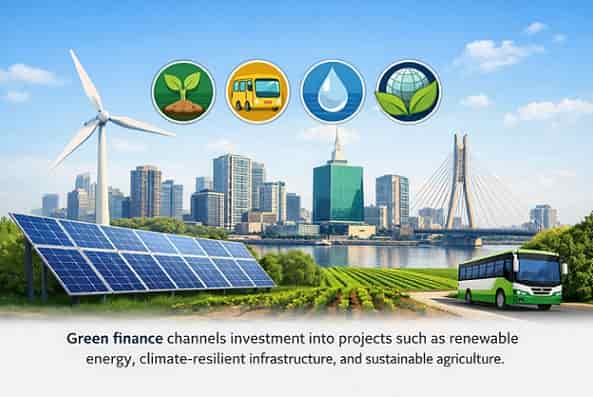
• Renewable Energy: Utility-scale solar farms and rural electrification programs.
• Sustainable Agriculture: Climate-smart farming, afforestation, and better land use.
• Clean Transportation: Low-carbon buses, electric mobility pilots, and CNG vehicles.
• Water & Flood Resilience: Flood-resistant infrastructure and sustainable water management, particularly in the Niger Delta and Middle Belt.
Opportunities for Investors
Institutional investors are already seeing tangible results. Nigerian pension funds are buying sovereign green bonds, asset managers are integrating ESG into mandates, and international investors continue to oversubscribe green instruments.
Retail investors aren’t left out either. Green bonds are regulated, accessible via the Nigerian Exchange Group (NGX), and increasingly appealing as Nigerian corporations adopt global ESG standards. Nigeria’s alignment with IFRS S1/S2 sustainability reporting means ESG disclosure is shifting from optional to expected, early adopters could gain a competitive edge.
Opportunities vs. Challenges
Challenges
• High debt financing raises risk concerns.
• Limited supply of bankable green projects.
• Weak ESG data disclosure complicates due diligence.
• Macroeconomic pressures (inflation, naira volatility).
• Fossil fuel dependency creates policy tension.
• Skills gap in green finance structuring.
Opportunities
• Energy access gap = massive solar investment potential.
• Net-Zero 2060 commitment provides policy clarity.
• State-level bonds (e.g., Lagos, Gombe) open local markets.
• Carbon credit markets offer untapped export potential.
• International climate funds actively seeking Nigerian partnerships.
• Growing domestic appetite from pension funds and insurers.
Nigeria in the African Context
Africa holds some of the world’s most promising green finance opportunities, from renewable energy to carbon sequestration (capturing and storing carbon dioxide to reduce greenhouse gases in the atmosphere).
Nigeria, as Africa’s largest economy, is leading the charge. Its frameworks, from green bond rules to ESG disclosure standards, are shaping the continent’s climate investment landscape.
The Bottom Line
Green finance is no longer niche. In Nigeria, it represents real instruments, real yields, and serious government commitment.
Investors, business owners, and policy watchers need to understand this evolving landscape, not just for environmental reasons, but for financial opportunity.
The real question isn’t whether Nigeria can grow a green finance market. It’s how fast investors, institutions, and businesses can act before the market fully catches up.
Keep reading
Related Topics




Conversation
Comments (0)
Sign in to join the conversation or like this post.