
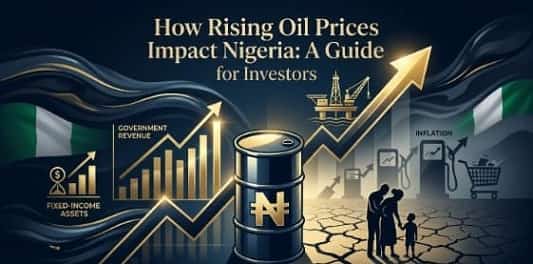
Every time global oil prices rise, Nigeria faces the same contradiction.
Higher crude prices boost government revenue and strengthen external reserves, yet at the same time, fuel prices climb, inflation accelerates, and households feel the pressure.
On paper, it looks like a win. In reality, it’s more complicated.
For investors, this recurring cycle isn’t just economic noise, it’s a pattern. And those who understand it can position ahead of the market, rather than react to it.
What typically drives oil price surges
Oil price rallies are usually triggered by a mix of fear and fundamentals.
Geopolitical tensions especially around key supply routes (like the current disruptions in the Strait of Hormuz) tend to push prices up quickly, sometimes overnight. Production cuts by major oil producers tighten supply further, while disruptions like pipeline shutdowns or sanctions add another layer of uncertainty.
Then there’s demand. When global economies recover or industrial activity picks up, oil consumption rises, and prices follow.
Investor insight: Oil price spikes create opportunity, but they also come with volatility. Entering late is where most people get burned.
The fiscal upside: Why higher oil prices benefit the government
When global oil prices rise above budget assumptions, Nigeria earns more revenue from each barrel exported. This boosts government income without requiring an increase in production.
Higher oil prices typically lead to
- Stronger foreign exchange inflows,
- Improved external reserves, and
- Increased Federation Account Allocation Committee (FAAC) allocations to states and local governments.
In the short term, this eases fiscal pressure, supports public spending, and can reduce the need for additional borrowing.
However, the benefit is largely price-driven and temporary, making it important to separate short-term fiscal relief from long-term economic strength.
The two Nigerias: Fiscal gains vs. consumer reality
This is where things split.
From the government’s perspective, rising oil prices are positive; higher revenue, stronger FX inflows, and more fiscal breathing room.
From the average Nigerian’s perspective, they often feel like a problem.
Why?
Because Nigeria exports crude oil but still depends heavily on imported refined fuel.
So when global oil prices increase, the cost of importing fuel rises, and that feeds directly into domestic fuel prices, especially in a deregulated environment.
But it doesn’t stop at the pump.
Higher fuel costs quickly spill into the broader economy, what starts as an oil price increase becomes a cost-of-living shock.
At the same time, wages don’t adjust as quickly, so real income falls, and households are forced to cut back.
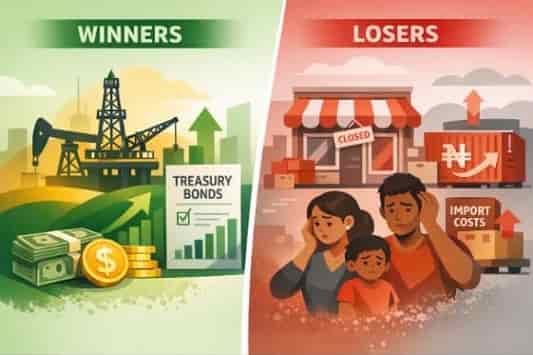
Winners and losers in a rising oil environment
Winners
- Upstream oil producers
- Investors holding dollar or FX-linked assets.
- Fixed-income investors benefiting from higher interest rates.
Losers
- Households dealing with higher living costs.
- Small businesses facing rising expenses.
- Import-heavy sectors with squeezed margins.
The Hidden Risks investors must understand
1. Cost-push inflation: Higher fuel prices don’t stay in the energy sector, they spread across the economy. Transport becomes more expensive. Food prices increase because distribution costs rise. Businesses face higher operating expenses and either raise prices or absorb losses.
Over time, this reduces purchasing power and weakens consumer demand.
2. Limited production upside: Nigeria doesn’t always benefit fully from high oil prices because production remains inconsistent. Issues like oil theft, pipeline vandalism, and underinvestment mean output often falls below potential.
So while prices may be high, volumes don’t always match and that limits total revenue gains.
3. Exchange rate pressures: Higher oil prices should support the naira, but it’s not guaranteed.
Exchange rate stability depends on a wider set of factors:
- Demand for foreign exchange
- External debt obligations
- Central bank policies
- Investor confidence
If demand for dollars remains high, the naira can still weaken despite strong oil prices.
4. Structural dependence: One of the biggest long-term risks is that higher oil prices can slow down reform. When revenues improve, there’s often less urgency to diversify the economy or fix underlying inefficiencies.
That means the same vulnerabilities remain, just temporarily masked.
The repeatable pattern
This is where things get interesting for investors. Nigeria’s oil cycles tend to follow a familiar path:
Oil prices rise → Government revenue improves → Fuel prices increase → Inflation picks up → Consumer spending weakens
It doesn’t happen perfectly every time, but the pattern shows up often enough to matter.
Recognizing this early gives you an advantage, you are not reacting to inflation, you are anticipating it.
Beyond oil: structural risks that don’t go away
Even during oil booms, Nigeria’s core economic weaknesses don’t disappear, they just become less visible.
The underlying issues remain:
- Production challenges
- Heavy import dependence
- Inflationary pressure
- Policy uncertainty
Oil price rallies can create opportunities, but they operate within a system that still has structural limitations.
That means:
- Gains may be short-term and uneven,
- Macroeconomic stability may be fragile beneath the surface,
- Long-term growth depends more on reform and diversification than oil prices alone,
What investors should do: A practical playbook
Understanding the oil cycle is one thing. Positioning for it is another.
When oil prices rise, the goal isn’t to react emotionally, it’s to adjust strategically.
1. Don’t chase the rally: Oil-driven opportunities often move fast. By the time headlines are loud, many assets have already priced in the upside.
What to do:
- Avoid buying into hype-driven spikes.
- Look for pullbacks or undervalued entry points.
- Focus on timing, not just direction.
2. Hedge against inflation: Rising oil prices typically lead to cost-push inflation, which quietly erodes real returns.
What to do:
- Allocate part of your portfolio to inflation-resistant assets.
- Prioritize investments that can adjust prices or yields upward.
- Avoid holding excessive idle cash.
3. Add FX exposure: Even with higher oil prices, currency stability is not guaranteed.
What to do:
- Hold some dollar-denominated assets.
- Use FX exposure as a hedge, not a speculation tool.
- Balance local investments with external value preservation.
4. Capture high yields while they last: High inflation environments often come with elevated interest rates.
What to do:
- Take advantage of Treasury Bills and fixed-income instruments.
- Lock in attractive yields before rate cycles shift.
- Use fixed income as a stabilizer in volatile periods.
5. Focus on sectors with pricing power: Not all businesses suffer during inflation, some adapt and pass costs on.
What to do:
- Look at essential sectors (food, logistics, energy).
- Prioritize companies that can maintain margins despite rising costs.
- Avoid businesses heavily dependent on imports without pricing flexibility.
6. Stay liquid and flexible: Oil price rallies driven by global events can reverse quickly.
What to do:
- Avoid overcommitting your capital.
- Keep some liquidity to take advantage of market corrections.
- Be ready to adjust your position as conditions change.
Final word
Rising oil prices in Nigeria are a double-edged sword.
They bring in more money at the top, but increase pressure at the bottom.
For investors, though, this isn’t a contradiction.
It’s a cycle.
And once you understand how that cycle works, you stop reacting to headlines, and start positioning ahead of them.
Keep reading
Related Topics




Conversation
Comments (0)
Sign in to join the conversation or like this post.