
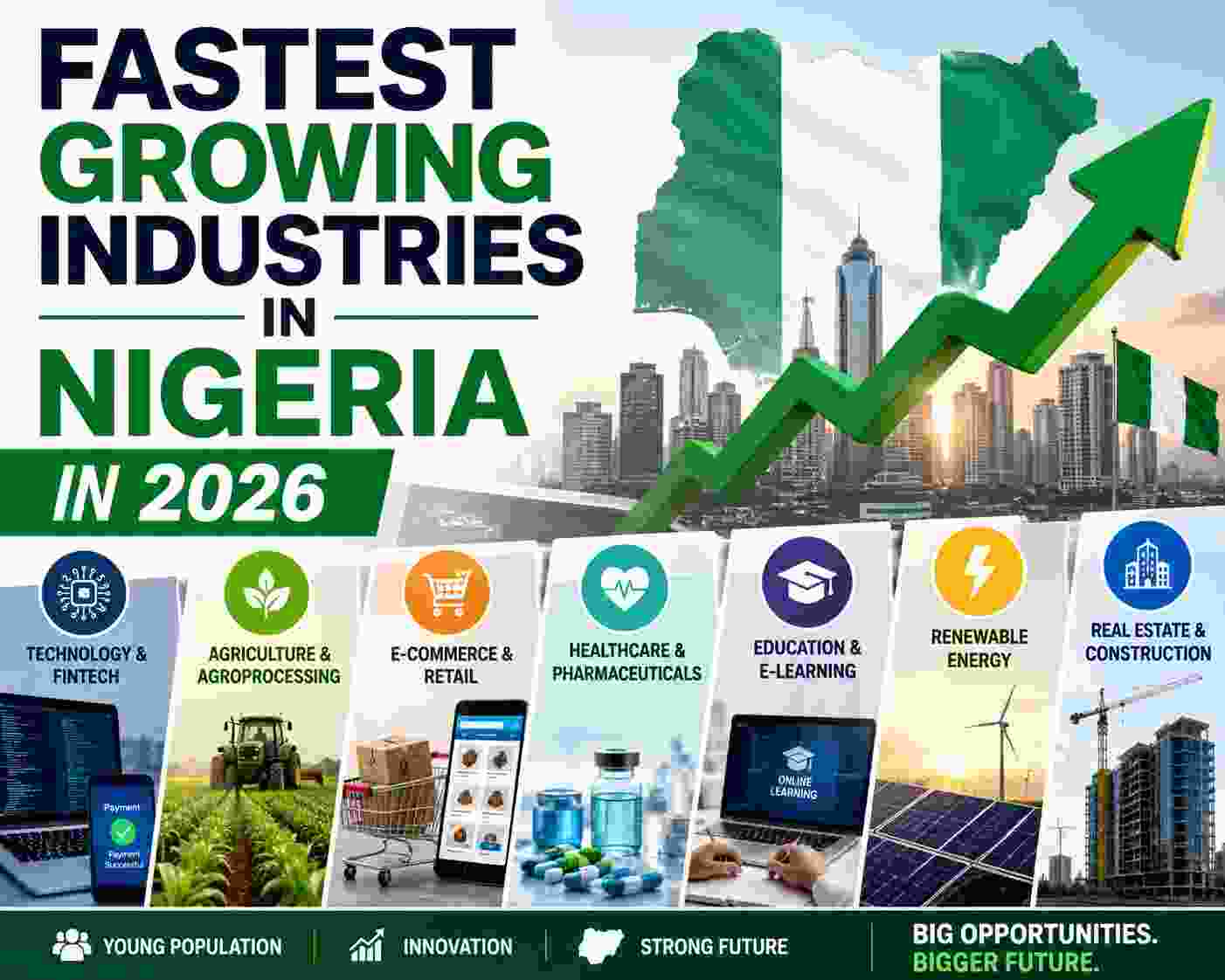
Nigeria’s economy is changing faster than many people realize.A few years ago, most young Nigerians wanted government jobs, banking jobs, or positions in large oil companies. Today, the conversation is different. People are learning digital skills, building online businesses, working remotely, launching startups, and exploring industries that barely existed a decade ago.The reason is simple: opportunities are shifting.
Some industries are growing rapidly because of technology. Some are growing because of population increase. Others are growing because Nigerians are finding new ways to solve everyday problems.
If you pay attention to where people are spending money, where investors are putting money, and where companies are hiring, certain industries stand out clearly.
These are the industries creating jobs, attracting investments, and producing new opportunities across Nigeria today.
Financial Technology (Fintech)
If there is one industry that has transformed everyday life in Nigeria and is growing so fast, it is fintech.
Think about how people used to transfer money ten years ago. Most transactions required visiting a bank physically. Long queues were normal. Sending money was slower and more stressful.
Today, millions of Nigerians transfer money from their phones within seconds.
People pay bills online. They save money digitally. They invest through mobile apps. Small business owners receive payments through POS terminals and payment platforms.This shift has created one of the fastest-growing industries in the country.
The growth is easy to see. Almost every Nigerian has used a fintech platform at some point. Whether it is sending money, buying airtime, paying bills, or saving money, digital finance has become part of daily life.
This growth has created opportunities for software developers, customer support specialists, product managers, marketers, compliance officers, cybersecurity experts, and business development professionals.The industry is still expanding because millions of Nigerians are joining the digital economy every year.
Technology and Artificial Intelligence
Technology is no longer a separate industry. It is becoming part of every industry.Banks use technology.Hospitals use technology.Schools use technology.Retail businesses use technology.Even farmers now use technology.
What has accelerated this growth recently is artificial intelligence.
Businesses are using AI tools to create content, automate customer service, generate reports, analyze data, design graphics, build websites, and improve productivity.
Tasks that once took days can now be completed within hours.This is creating huge demand for people who understand technology.
Web developers, software engineers, AI specialists, cybersecurity professionals, data analysts, UI/UX designers, and automation experts are becoming increasingly valuable.
One practical example is website development.
A few years ago, building a professional website required extensive coding knowledge. Today, AI tools have simplified the process, allowing developers to work faster and businesses to launch websites more quickly.
Companies are adopting these technologies because they save time and reduce costs.
E-Commerce
The way Nigerians shop has changed significantlyMany people now buy products without entering physical stores.
Phones, clothing, electronics, beauty products, groceries, and household items are increasingly purchased online.
The rise of social media has contributed heavily to this growth.
Today, someone can discover a product on Instagram, place an order on WhatsApp, make payment online, and receive delivery within hours.Many small businesses now operate entirely online.
Some business owners have never rented a physical shop. Their Instagram page, TikTok account, Facebook page, or website serves as their storefront.This shift has created opportunities for online sellers, website developers, digital marketers, customer support agents, photographers, videographers, and logistics companies.
As internet access continues improving, e-commerce is expected to keep growing.
Digital Marketing and Online Advertising
Businesses no longer compete only on product quality.They compete for attention.
This is one reason digital marketing has become one of Nigeria’s fastest-growing industries.Every business wants visibility.Every business wants customers.Every business wants sales.And increasingly, those customers are online.
As a result, businesses are spending more money on social media advertising, Google advertising, influencer marketing, email marketing, search engine optimization, and content marketing.
A restaurant wants more customers.A real estate company wants more buyers.A fashion brand wants more orders.A school wants more admissions.Digital marketing helps achieve those goals.
This industry has created opportunities for social media managers, content creators, graphic designers, media buyers, SEO specialists, copywriters, and brand strategists.What makes this industry attractive is that many professionals can work remotely for clients across Nigeria and even internationally.
Logistics and Delivery Services
One industry that often goes unnoticed is logistics.But without logistics, many modern businesses would struggle to operate.
Every online order needs delivery.Every business needs supplies.Every store needs inventory.Every manufacturer needs transportation.The growth of online shopping has created enormous demand for delivery services.
In major cities like Lagos, Abuja, Port Harcourt, Kano, and Ibadan, dispatch riders have become a normal part of daily life.Customers increasingly expect faster deliveries.Businesses are investing heavily in logistics because customer satisfaction often depends on delivery speed.
As e-commerce grows, logistics grows alongside it.The two industries are closely connected.
Agriculture and Agribusiness
Agriculture remains one of the most important industries in Nigeria.But modern agriculture is very different from what many people imagine.
Agriculture today involves much more than planting crops.
There is food processing food packaging, storage, transportation, exportation, agricultural technology, farm consulting and livestock production. The opportunity often extends beyond farming itself.
For example, some entrepreneurs earn more processing agricultural products than growing them.Others make money supplying equipment, fertilizers, seeds, or technology solutions to farmers.
Nigeria’s growing population means food demand continues increasing every year.People must eat regardless of economic conditions.That is one reason agriculture continues attracting investments and creating opportunities.
Renewable Energy
Nigeria’s energy challenges have created opportunities for an entirely new industry. As fuel prices rise and electricity supply remains inconsistent in many areas, more individuals and businesses are turning to alternative energy solutions. Solar power has become particularly popular.
Today, many homes, schools, offices, hospitals, and businesses are installing solar systems.What was once considered expensive is now increasingly viewed as a long-term investment.The industry has created opportunities for solar installers, technicians, engineers, equipment suppliers, sales professionals, and energy consultants.As electricity demand continues growing, renewable energy is expected to expand significantly.
Healthcare and Health Technology
Healthcare is another industry experiencing strong growth. Nigeria’s population continues increasing, creating greater demand for medical services. People are also becoming more health-conscious.
Many Nigerians now prioritize regular medical checkups, diagnostic testing, preventive care, and health monitoring. Technology is also changing healthcare. Patients can consult doctors remotely.Medical records can be stored digitally. Appointments can be booked online. Health apps are becoming more common. This combination of healthcare and technology has created opportunities beyond traditional medical roles.
Health-tech startups, telemedicine platforms, medical equipment suppliers, diagnostic centers, pharmacies, and healthcare consultants are all benefiting from this growth.
Real Estate and Construction
Nigeria’s population continues to grow rapidly. More people need housing. More businesses need office space.More schools, hospitals, shopping centers, and warehouses need to be built. This demand continues driving growth in real estate and construction.The opportunity goes beyond property developers.
Architects, engineers, quantity surveyors, interior designers, facility managers, artisans, and construction professionals all benefit from industry growth. Urban areas continue expanding as more people relocate to cities in search of opportunities.This increases demand for residential and commercial properties.
Despite economic challenges, housing demand remains strong because shelter is a basic necessity.
Education Technology (EdTech)
Education is changing. More Nigerians are learning online than ever before.People now take professional courses, learn digital skills, attend virtual classes, and earn certifications without entering traditional classrooms.
The popularity of online learning increased dramatically in recent years and continues growing. Students want flexibility. Working professionals want affordable ways to learn new skills. Businesses want employees who can improve their knowledge continuously. This has created opportunities for online tutors, course creators, educational platforms, instructional designers, and training companies.
As technology becomes more integrated into education, this industry is likely to expand even further.
Final Thoughts
The fastest-growing industries in Nigeria are not growing by accident. They are growing because they solve real problems. Fintech makes financial transactions easier.Technology helps businesses operate more efficiently. E-commerce makes shopping more convenient.The common factor across all these industries is demand.
People need these services. Businesses need these services. And as long as that demand continues increasing, opportunities will continue emerging. For job seekers, entrepreneurs, freelancers, and investors, understanding where growth is happening is often the first step toward identifying where future opportunities will come from.
Keep reading
Related Topics





Conversation
Comments (0)
Sign in to join the conversation or like this post.