
Don’t Put All Your Investment Eggs in One Basket: A Practical Guide to Diversification
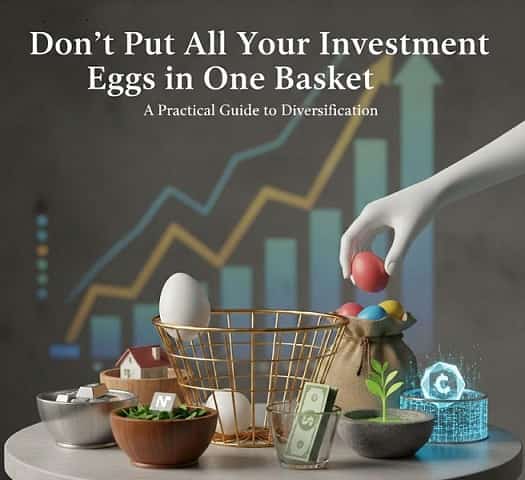
There’s a reason the saying “don’t put all your eggs in one basket” has survived generations, it’s painfully accurate in investing.
Markets move. Assets crash. Entire sectors have bad years. When all your money rides on one investment, one bad event can wipe you out. That’s where diversification comes in, not as a buzzword, but as a survival strategy.
What Diversification Really Means
Diversification is a risk management strategy that spreads your money across different investments so you’re not dependent on a single asset, sector, or location.
Those “baskets” you’re spreading your eggs across are called asset classes, such as:
• Treasury bills and other fixed-income instruments
• Stocks (equities)
• Real estate
• Commodities (like gold and silver)
• Crypto
• Cash or cash equivalents
This mix is also known as asset allocation (deciding what percentage of your portfolio goes into each basket). The goal isn’t to eliminate risk (that’s impossible), but to reduce the chances of catastrophic loss while still earning reasonable returns.
Why Diversification Matters
People invest because they want returns. That’s the whole point. But returns don’t come without risk and not all assets move in sync (they’re often negatively correlated, so one zig can offset another zag).
Diversification helps because:
- When one investment performs badly, others may perform well.
- Losses in one area can be offset by gains in another.
- Your portfolio becomes more stable over time.
In short: diversification smooths the ride. Fewer heart attacks. Fewer regrets.
The Different Ways to Diversify
1. Across Asset Classes: Stocks may offer high returns but are volatile. Bonds are steadier but slower. Real estate hedges inflation. Crypto… well, crypto is crypto.
Examples of balancing risk and reward:
• Stocks for growth
• Bonds/fixed income for stability
• Real estate for income and inflation protection
• Commodities/alternatives for balance
Diversifying doesn’t automatically mean investing more money. It means investing smarter.
2. Across Geography: Putting all your money in one country exposes you to that country’s economic and political risks, like currency volatility or policy shifts.
Ways to diversify geographically:
• Invest in companies operating in multiple countries.
• Own international mutual or index funds.
• Hold real estate in different locations, even within the same city.
Global exposure means one country sneezing won’t give your entire portfolio the flu.
3. Within Markets: Even within a single asset class, diversification matters. Spread investments across:
- Industries/sectors (tech, healthcare, finance, energy, etc.).
- Company sizes (large-cap, mid-cap, small-cap)
You don’t want your portfolio’s fate tied to one sector having a bad year.
Can You Over-Diversify? Yes.
More baskets aren’t always better. Over-diversifying can:
• Increase transaction costs (buying and selling too many assets eats into returns).
• Make tracking performance difficult (too many investments get confusing).
• Add complexity without improving returns (spreading too thin can dilute gains).
The goal: balance, not chaos.

How to Fix Over-Diversification
a) Review your portfolio: List all investments and note their asset class, sector, and geography.
b) Identify redundancies: Trim overlapping assets that don’t add value.
c) Prioritize core holdings: Keep investments aligned with your goals and risk tolerance.
d) Use low-cost diversification tools: Index funds or ETFs can cover multiple assets at once.
e) Set clear allocation targets: Decide what % goes into stocks, bonds, real estate, etc.
f) Rebalance regularly: Adjust holdings periodically to maintain your target allocation.
Key idea: Diversify smartly, not endlessly. Quality over quantity.
What About Small Investors?
Diversification isn’t reserved for the wealthy. You don’t need millions to invest.
Options for small investors include:
• Mutual funds: pool your money with other investors while professionals manage the portfolio.
• Index funds: low-cost funds that track entire market indices, giving you broad market exposure.
• Real Estate Investment Trusts (REITs): invest in properties without buying physical real estate, providing lower-cost exposure.
These tools let you own a diversified portfolio with relatively small capital, making investing efficient, simple, and accessible.
You don’t need millions; you need consistency.
A Word of Caution: Not All Baskets Are Safe
Diversification won’t protect you if you invest blindly.
Do your due diligence:
• Understand what you’re investing in and where your money is going
• Verify platforms and fund managers; avoid scams or poorly structured investments
• Be realistic about promised returns
A bad investment multiplied across baskets is still a bad investment.
A Note for Beginner Investors
Before investing, master one underrated skill: saving.
Set aside small amounts regularly as consistency beats timing.
Waiting for “more money” often just means waiting forever, and ironically, more money usually brings more expenses.
Start small. Build discipline. Scale intelligently.
The Bottom Line
Diversification won’t make you rich overnight, and it won’t protect you from every loss. But it will protect you from putting your entire financial future at the mercy of one bad decision.
Smart investors don’t chase the hottest asset, they build portfolios that can survive the cold.
Keep reading
Related Topics






Conversation
Comments (0)
Sign in to join the conversation or like this post.