
Dangote Refinery Sets ₦525 IPO Price as Africa’s Biggest-Ever Share Sale Takes Shape
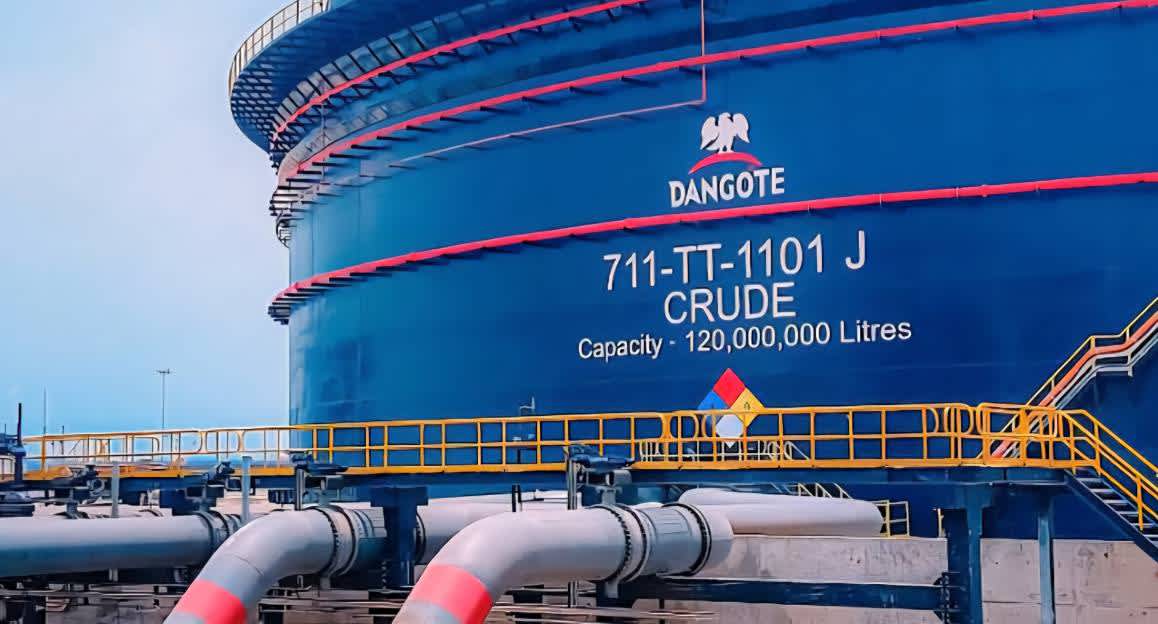
Dangote Petroleum Refinery is set to make history on the Nigerian Exchange (NGX), with its highly anticipated initial public offering (IPO) priced at ₦525 per share and the order book expected to open on September 14, 2026.
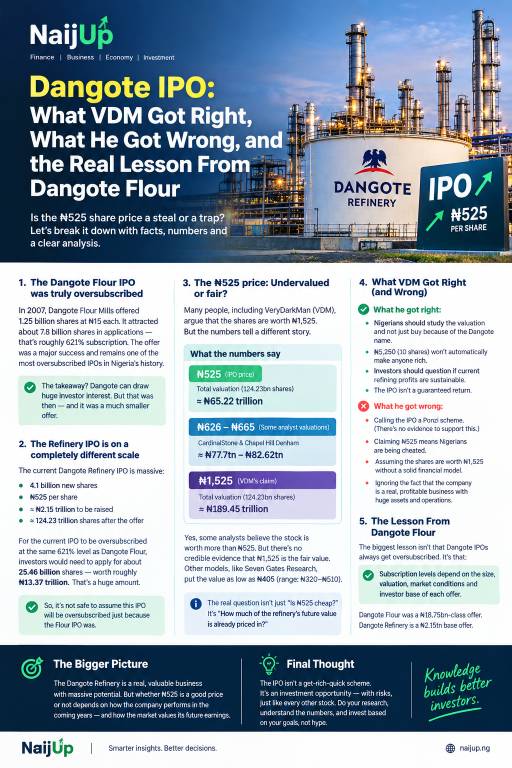
The proposed IPO could raise about ₦2.15 trillion, or roughly $1.6 billion, from the sale of 4.1 billion ordinary shares, making it potentially the largest IPO in African capital-market history.
According to reports citing sources familiar with the transaction, the offering will also have a 15% greenshoe option, which could allow additional shares to be sold if investor demand is strong.
The development comes only weeks after Dangote Refinery attracted significant investor interest through a $2.5 billion private placement that reportedly valued the company at around $40 billion.
Dangote Refinery IPO at a Glance
| IPO detail | Information |
|---|---|
| Offer price | ₦525 per share |
| Shares on offer | 4.1 billion |
| Potential proceeds | About ₦2.15 trillion |
| Dollar value | About $1.55bn–$1.8bn |
| Greenshoe option | 15% |
| Expected order book opening | September 14, 2026 |
| Primary listing | Nigerian Exchange (NGX) |
| Current refining capacity | 650,000 barrels per day |
| Planned future capacity | 1.4 million barrels per day |
The final terms remain subject to the official offer documentation and regulatory process.
What Is Dangote Refinery?
Dangote Petroleum Refinery is one of the most ambitious industrial projects ever undertaken in Nigeria.
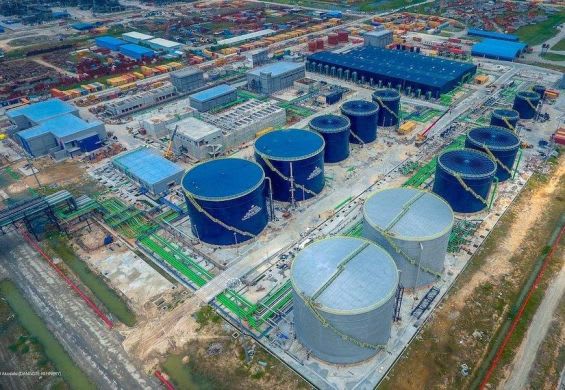
Located within the Lekki Free Zone in Lagos, the refinery occupies roughly 2,500–2,635 hectares and has a nameplate capacity of 650,000 barrels of crude oil per day.
It is Africa's largest refinery and the world's largest single-train refinery, meaning its refining capacity is concentrated in one processing train rather than spread across several trains.
The facility is owned by Dangote Industries and forms part of the wider business empire founded by billionaire businessman Aliko Dangote.
Construction of the refinery took years and required billions of dollars in investment. The facility eventually began commercial operations in January 2024 after a long development period.
Its importance to Nigeria is difficult to overstate. Nigeria has historically exported crude oil while importing significant quantities of refined petroleum products. Dangote Refinery was built to help close that gap by processing crude domestically and supplying products such as petrol, diesel, aviation fuel and other petroleum products.
From $20 Billion Mega-Project to Public Company
The refinery was built at a reported cost of around $20 billion, making it one of Africa's largest private-sector industrial investments.
Its development involved extensive infrastructure work, including land reclamation at the Lekki site. The company's own account says approximately 70% of the site was swamp and required major land reclamation and sand-filling work.
The refinery has since moved from being a massive construction project to becoming a major player in Nigeria's petroleum market.
The facility reached its full 650,000-barrel-per-day nameplate capacity earlier in 2026, according to Reuters, although actual production can vary depending on operations and crude availability
Why Is Dangote Refinery Going Public?
The IPO is not simply about selling shares to investors.
A major objective is to raise capital for expansion.
Dangote has announced plans to eventually increase the refinery's capacity from 650,000 barrels per day to approximately 1.4 million barrels per day.
That would make the facility an even more significant player in the global refining industry and could substantially increase its ability to supply petroleum products to Nigeria and export markets.
The IPO therefore gives investors an opportunity to participate in the future expansion of one of Africa's largest industrial assets.
How Much Could Dangote Refinery Be Worth?
At the reported IPO price of ₦525, the refinery is being positioned at a valuation running into tens of billions of dollars.
Recent reporting puts the company's valuation at approximately $40 billion to $50 billion, depending on the transaction assumptions and valuation methodology. Reuters reported that the company had about 120.13 billion existing registered ordinary shares.
That makes the IPO particularly significant for Nigeria's capital market.
Investors will essentially be deciding whether the future earnings potential of the refinery justifies a valuation of this scale.
Why the IPO Could Be Historic for Nigeria
The size of the proposed transaction would make the Dangote Refinery IPO considerably larger than previous major Nigerian equity offerings.
More importantly, it would bring one of Africa's largest industrial assets directly into the Nigerian capital market.
The transaction could also deepen the NGX by giving Nigerian investors exposure to a large-scale energy and industrial business whose operations extend beyond the domestic market.
Dangote Refinery has increasingly become an exporter of refined petroleum products, meaning its earnings potential is not solely dependent on Nigerian consumers.
What Will Dangote Use the Money For?
The major focus is expected to be capacity expansion.
Dangote's plan is to increase refining capacity to around 1.4 million barrels per day. The company has also been strengthening its balance sheet ahead of the public offering.
The refinery reportedly completed a $2.5 billion private placement in July 2026, while a further $1 billion underwriting programme has also been reported.
This suggests the IPO is part of a broader capital-raising strategy rather than an isolated transaction.
What Investors Should Watch
Despite the excitement surrounding the IPO, the Dangote Refinery story comes with important issues investors will need to consider.
1. Crude oil supply
A refinery can only operate efficiently if it has reliable access to crude at competitive prices.
Reports have highlighted challenges surrounding the cost and availability of Nigerian crude, with the refinery sourcing some crude internationally. Nigerian authorities have been considering changes to crude supply arrangements to improve access for domestic refiners.
2. Refining margins
The refinery's profitability will depend heavily on the difference between the cost of crude oil and the prices it can obtain for refined products.
Strong refining margins could produce substantial profits, while weaker margins could put pressure on earnings.
3. Expansion costs
Increasing capacity from 650,000 barrels per day to 1.4 million barrels per day will require significant additional capital.
Investors will therefore want to know how much of the expansion will be financed through IPO proceeds, debt and internally generated cash.
4. Valuation
Perhaps the biggest question is whether the proposed valuation provides enough upside for new shareholders.
A company can be excellent while its shares are still expensive.
At a potential valuation approaching $50 billion, investors will likely scrutinise revenue, profitability, debt, cash flow and future refining margins closely.
What the Dangote IPO Means for Nigerians
The IPO could represent an important moment for Nigeria's investment market.
Instead of Dangote Refinery remaining entirely under private ownership, Nigerians and institutional investors will have an opportunity to own a portion of the company through the stock market.
It could also encourage more large Nigerian privately owned companies to consider the capital market as a source of long-term funding.
For the Nigerian government, a successful Dangote Refinery could also support the country's broader goal of reducing dependence on imported refined petroleum products.
The Bigger Picture
The Dangote Refinery is no longer simply a Nigerian refinery.
It is increasingly becoming an African energy and export business.
The facility's location on the Lagos coast gives it access to international shipping routes, allowing it to source crude from different markets and export refined products.
The company has also benefited from increased international demand for refined products, while Dangote Group has broader ambitions for refining operations across Africa.
If the IPO succeeds, Dangote Refinery could become one of the most important publicly traded industrial companies in Africa.
The ₦525 Dangote Refinery IPO is shaping up to be much more than another Nigerian stock-market listing.
With 4.1 billion shares on offer, a potential ₦2.15 trillion raise, a 15% greenshoe option and a planned September 14 order-book opening, the transaction could become the largest IPO Africa has ever seen.
For Dangote, the IPO provides capital to pursue its ambition of increasing refining capacity to 1.4 million barrels per day.
For the NGX, it could bring one of Africa's largest industrial businesses into the public market.
And for investors, the central question will be straightforward: is Dangote Refinery's future growth and profitability worth the valuation being placed on the company?
Keep reading
Related Topics



Conversation
Comments (0)
Sign in to join the conversation or like this post.

Mujeeb Olagunju
I am a finance professional with a strong background in economics and financial technology.,My work centers on building systems that support payments, digital banking, and investment solutions in emerging markets.,I have experience with risk management, transaction monitoring, fraud prevention, and the design of scalable financial products tailored to both retail and institutional clients.,With over 8 years of industry experience, I combine financial insight with technical expertise to deliver solutions that balance compliance, security, and business growth.,My goal is to bridge the gap between finance and technology, creating platforms that expand access to modern financial services and strengthen trust in digital finance.
75
Stories
23193
Reads
0
Likes
0
Comments
Latest by Mujeeb Olagunju
Village Prices Fell in September, But Not Where It Counts: Transport and School Fees Shot Up
general
Imported Food Is Now Rising Half as Fast as Food Grown in Nigeria. Here's What the NBS Numbers Show
general
Clothing Prices Rose Just 1.08% in a Year: The Six Things Inflation Almost Forgot in Nigeria
general