
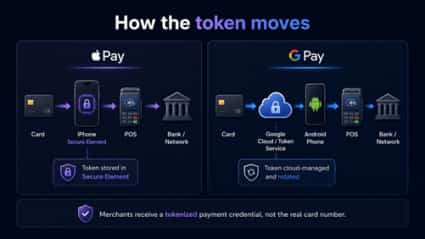
Digital wallets have changed how card payments work. Whether you use Apple Pay or Google Pay, the main idea is the same: your real card number is not shared directly with the merchant.
Instead, both systems replace your card details with a payment token. But the big difference is where that token lives and how each platform manages trust.
Apple Pay: Hardware-First Security
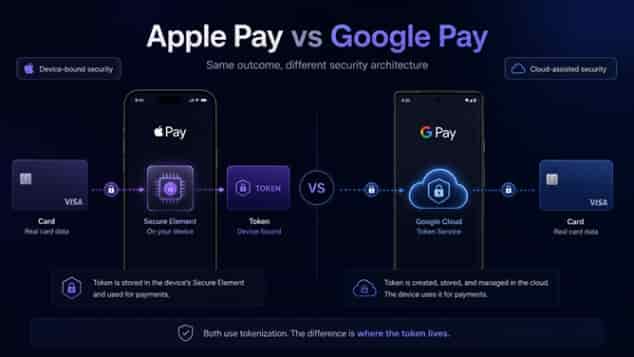
Apple Pay uses a device-bound security model.
When you add a card to your iPhone, the card details are sent securely to Apple, then forwarded to the payment network’s Token Service Provider, such as Visa or Mastercard.
The Token Service Provider creates a Device Account Number, also called a DAN. This token is stored inside the iPhone’s Secure Element chip, a dedicated hardware security component.
At checkout, Apple Pay does not send your real card number. Instead, the device sends the DAN plus a one-time security code through NFC.
The key point: the payment token lives inside the device hardware, not on Apple’s servers.
That gives Apple Pay a narrower attack surface and a strong hardware-based security model.
Google Pay: Cloud-Assisted Flexibility
Google Pay takes a slightly different path.
When you add a card, Google sends the card information to the Token Service Provider. The provider then creates a payment token, which is managed through Google’s cloud-based system and pushed to the device for use.
At checkout, the phone transmits the token through NFC, and the payment network de-tokenizes it before the issuer authorizes the transaction.
Google Pay leans more on cloud management, token rotation, and multi-device flexibility.
This makes it easier to support different Android devices, web payments, and account-based experiences, while still protecting the real card number from merchants.
The Real Difference
Apple Pay is more hardware-isolated. Google Pay is more cloud-flexible.
Apple’s model is device-bound and deeply tied to the iPhone’s Secure Element. Google’s model is more adaptable across devices and services.
But the outcome is similar: the merchant does not receive your real PAN, which reduces exposure when compared to raw card entry.
Why Merchants Should Care
For merchants, wallet payments are not just about convenience. They represent a more trusted payment flow.
When customers pay with Apple Pay or Google Pay, the transaction usually comes with stronger authentication, tokenized card data, and reduced risk of exposing sensitive card information.
That means better customer confidence, smoother checkout, and potentially lower fraud risk.
The takeaway: Apple Pay and Google Pay may use different security architectures, but they both point to the same future — safer, faster, and more trusted digital payments.
Keep reading
Related Topics






Conversation
Comments (0)
Sign in to join the conversation or like this post.