

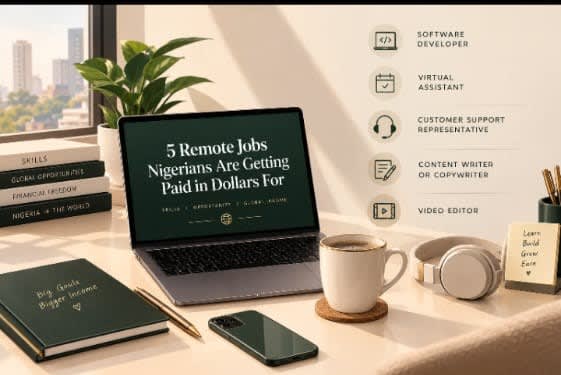
Skills that turn a laptop and a stable connection into a dollar income, with no relocation required.
If you open one Nigerian WhatsApp group that has up to 20 members, chances are at least one person is hustling one form of remote work, writing for a client in Canada, designing logos for a startup in Berlin, or coding for a company that they have never even seen face-to-face. This means the global demand for skilled remote talent is going higher, and Nigerians are answering the call in numbers.
Remote freelance job postings grew by over 20% in the first half of 2026 alone, and companies from the US, UK, Canada, and beyond are actively hiring outside their borders because it's simply cheaper and faster to access specialized skills globally than to hire locally. For a Nigerian with the right skill, the right platform, and a reliable way to receive payment, this is one of the clearest paths to earning in dollars, pounds, or euros without stepping on a plane.
This post breaks down the specific freelance skills that companies abroad are actively paying for right now, what you can realistically earn, and how to position yourself to start landing these gigs.
1. Software Development and Web Development
This one has not really changed position for years, and 2026 will be no exception. Companies always need people who can build, maintain, or fix their websites, apps, and internal tools, and they don't care whether the developer is sitting in San Francisco or Surulere.
Remote software developers currently earn between $15 and $100 per hour depending on stack and experience, with average remote salaries for developers sitting well above what equivalent office-based roles pay. If you know JavaScript, Python, React, or backend frameworks, you can get access to one of the widest and highest-paying freelance markets that exists.
Why companies pay for it
- Every business now needs a digital presence: websites, apps, dashboards, and automation.
- Development work is fully remote-compatible; code na code, whether you are in Lagos or London.
- There's a global shortage of experienced developers relative to demand.
2. AI, Machine Learning, and Prompt Engineering
AI has become the single fastest-growing category for freelance skills. According to recent industry data (Upwork), AI-related freelance work grew over 100% year-on-year, with niches like AI video editing growing even faster. LLM development specialists command $50 to $150 per hour, with machine learning experts earning $50-$200, while computer vision engineers earn $30 to $100 per hour.
You don't need to be a PhD holder to enter this space anymore. Prompt engineering, AI workflow automation, and fine-tuning existing models for specific business use cases are all skills a determined Nigerian can build within months through structured self-study, and companies abroad pay well for people who can apply AI practically to solve real business problems.
3. Cybersecurity
As more businesses move online, the risk of attack grows faster than the workforce trained to prevent them. Projections put cybersecurity job growth at 29% to 32% through the late 2020s and early 2030s, far ahead of the average for other occupations.
Freelancers in penetration testing and security auditing earn $60 to $250 per hour, and cybersecurity gig postings on platforms like Upwork rose by 20% year-on-year. If you have any background in IT, networking, or ethical hacking, this is a skill you can fit into and immediately use to access foreign clients who are in need of protection.
4. Content Writing and Copywriting
This one remains one of the most accessible entry points for Nigerians into the global freelance economy, and rightly so; every business, blog, SaaS company, and newsletter needs words that convert or inform. Beginners can start at $10 to $30 per article, while experienced copywriters who know how to write for SaaS, fintech, or e-commerce brands charge $100 to $250+ per piece, with some specialized writers earning $150 per hour.
The trick is specialization. General blog writers can compete with thousands of others; a writer who positions themselves as "the person who writes SaaS onboarding emails" or "the copywriter for fintech landing pages" will always find better-paying clients.

5. Data Analysis and Data Science
This skill is transferable across every industry: finance, e-commerce, health tech, and even agritech companies. They need people who can make sense of their numbers. Companies abroad pay data analysts and data scientists $2,000 to $6,000 monthly for consistent contract work, with hourly rates for specialized data science work ranging as high as $35 to $250 per hour depending on complexity.
If you can clean data, build dashboards, run analysis in Excel, SQL, or Python, and translate numbers into insight a business can act on, you possess a skill set international companies badly need, especially finance, e-commerce, and health tech companies that process large volumes of data daily.
6. Graphic Design and UI/UX Design
Every brand needs visuals, logos, pitch decks, app interfaces, and social media graphics. Global remote salaries for design roles sit between $55,000 and $120,000 annually with strong year-on-year growth, and Nigerian designers who build a portfolio showcasing global-standard work land these gigs.
Tools like Figma, Adobe Illustrator, and Canva Pro make entry accessible, but the real differentiator is a portfolio that shows process and not just the final design but also how you solved the client's actual problem.
7. Digital Marketing and SEO
Companies abroad constantly need people who can manage their online visibility: SEO specialists, paid ads managers, social media strategists, and email marketers. Digital marketing freelancers earn between $45,000 and $78,000 annually on average, and this is one skill area where a Nigerian with strong analytical thinking (and good grammar) can thrive.
Familiarity with tools like SEMrush, Ahrefs, Google Analytics, and Meta Ads Manager will set you apart quickly, since most clients want proof you can read numbers and adjust strategy, not just "post content."
8. Virtual Assistance and Executive Support
This category is underrated but very stable. Businesses, especially solo founders and small teams abroad, need people to manage their calendars, inbox, scheduling, and admin work. Entry-level virtual assistant roles pay $5 to $20 per hour, and experienced VAs who specialize in executive support or niche industries (like real estate or e-commerce) can earn significantly more.
It's one of the lowest-barrier ways to start earning dollars while you build toward a more specialized skill on the side.
9. Video Editing and AI Video Production
Video content continues to dominate marketing and social media, and AI-assisted video editing specifically grew over 300% year-on-year, one of the fastest-growing freelance niches tracked in 2026. Companies need short-form content for TikTok, Reels, YouTube, and ads, edited fast and consistently.
Basic skills in CapCut, Premiere Pro, or DaVinci Resolve, paired with an understanding of what makes content perform on each platform, are enough to start landing clients.
How Nigerians Are Actually Getting Paid
Landing the client is half the story; receiving the money well is the other half. Nigerians can now receive international payments on PayPal, but not entirely on its own; you must link your PayPal account to the local fintech platform Paga to receive funds and withdraw them into naira, following the partnership both companies announced in January 2026. Outside of that, most Nigerian freelancers still use a combination of these:
- Payoneer, the default for Upwork and Fiverr withdrawals, integrates directly with both platforms.
- Grey and Geegpay are popular for direct client payments in USD, GBP, and EUR, with easier conversion to naira.
- Wise; generally offers the best FX rates for currency conversion.
- Cleva and Raenest: growing options for managing foreign currency balances before converting.
One practical tip experienced freelancers swear by: don't rush to convert your dollars to naira immediately. Holding earnings for a few days and converting when the rate is more favorable can add meaningfully to annual income, not speculation, just smart timing.
The Bottom Line
Some of the skills that pay best abroad are software development, data analysis, product design, digital marketing, AI, and cybersecurity; they are also the ones that take time to build. But even the more accessible ones, like writing, design, or virtual assistance, can still translate to a real dollar income if you specialize, build a portfolio that shows results, and treat client relationships as something to retain, not just transact.
The naira has stabilized at a level that, while painful for importers, is almost perversely beneficial for Nigerians earning in foreign currency.
For skilled Nigerians willing to put in the work of learning a skill properly and pitching consistently, this exchange-rate reality means the same hour of work, done for a foreign client instead of a local one, can change your financial life. The opportunity is there. The only question is which skill you are going to pick up first.
Keep reading
Related Topics




Conversation
Comments (0)
Sign in to join the conversation or like this post.

Elizabeth Ayoola
Elizabeth is a finance analyst and writer passionate about making financial markets accessible to everyday readers.
She has a deep interest in global markets, crypto, and everything shaping the financial world. She writes to simplify complex financial topics, turning them into practical, accessible insights for everyday readers.
108
Stories
36004
Reads
1
Likes
0
Comments