
PayPal Returns to Nigeria Through Paga — 20 Years Late, But Right on Time?
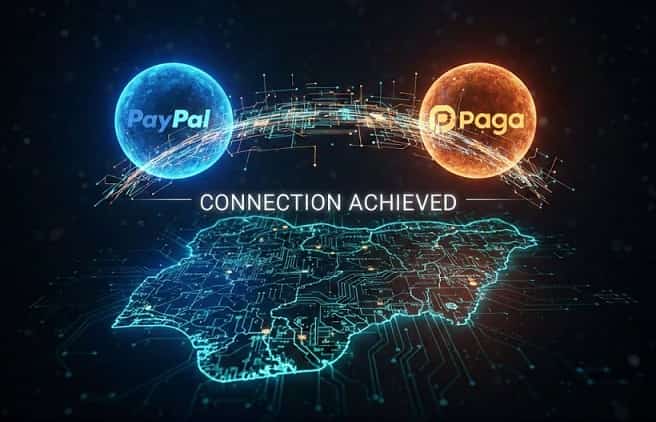
After nearly two decades of limiting Nigerian users to “send-only” transactions, PayPal is finally reopening inbound payments, through a partnership with local fintech giant Paga.
The announcement, shared by Paga’s founder and Group CEO Tayo Oviosu on January 27, 2026, marks a major shift in PayPal’s long-restricted relationship with Africa’s largest economy. Nigerians can now receive international payments, withdraw funds in naira, and access PayPal’s global network, functionality unavailable since 2004. For freelancers, merchants, and digital workers, this is a long-awaited change.
But this return didn’t happen overnight. It took 13 years, a maturing fintech ecosystem, and a complete rethink of how global payment firms enter frontier markets.
A 13-year email finally gets a reply
Oviosu revealed he first reached out to PayPal in August 2013, when Nigeria’s fintech ecosystem was in its infancy and the “Africa opportunity” barely featured in global boardroom conversations.
Paga was only a few years old. Nigeria lacked unified digital identity systems, real-time payments infrastructure, and cohesive regulatory oversight. Still, Oviosu believed Nigeria would become one of the world’s most important economies, and that PayPal and Paga were natural partners.
He pitched a simple but bold idea: Nigeria would emerge as a global economic force, with Paga serving as PayPal’s local on-ramp and off-ramp for payments, compliance, and settlement.
That belief took over a decade to materialize.
“Today, I’m proud to share that PayPal is now live in Nigeria through Paga,” Oviosu said, framing the moment as the result of patience, trust-building, and sustained investment in local infrastructure, not a sudden breakthrough.
Why PayPal locked Nigerians out for 20 years
PayPal’s relationship with Nigeria has long been complicated.
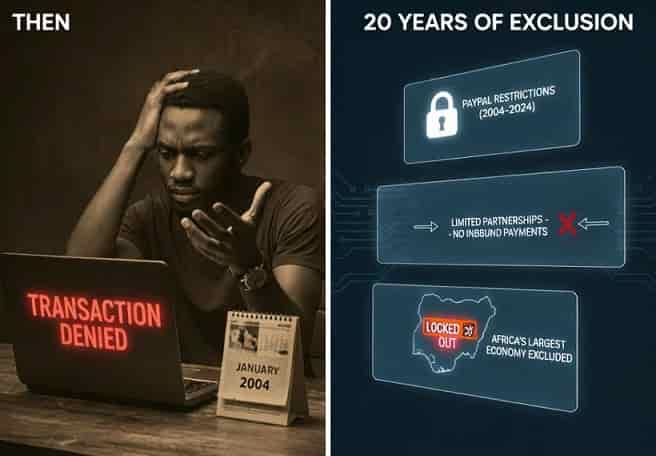
In 2004, the company restricted Nigerian accounts to send-only status, citing high fraud risk, weak identity systems, and regulatory challenges. Nigerians could pay for services abroad but couldn’t receive money, withdraw earnings, or fully participate in global digital commerce.
Limited partnerships followed: a 2014 deal with First Bank for outbound payments, and a 2021 collaboration with Flutterwave for merchants. Neither enabled inbound payments for individuals.
The result? Exclusion.
Freelancers, creators, and online businesses relied on alternatives, intermediaries, or informal workarounds at higher costs and greater risk. Africa’s largest economy was locked out of one of the world’s key digital payment platforms.
What’s different this time?
The PayPal–Paga partnership unlocks inbound payments. Under the new setup:
• Users can link PayPal accounts to Paga wallets.
• Receive funds from over 200 countries.
• Convert and withdraw balances in naira.
• View PayPal balances inside the Paga app.
• Merchants can accept PayPal in up to 25 currencies.
• Nigerians can receive payments from US Venmo users.
For freelancers and gig workers, this means global payouts without hacks. For the diaspora, it’s a new remittance route. For merchants, it taps PayPal’s 400+ million users.
Why PayPal is betting on Paga
PayPal isn’t re-entering alone, that’s the critical difference.
PayPal leverages Paga’s APIs, compliance framework, and merchant network, instead of rebuilding local infrastructure from scratch, embedding into scaled local platforms rather than building compliance from scratch.
Paga delivers:
- Over 21 million users.
- Robust API (Application Programming Interface) infrastructure.
- Deep merchant and agent networks.
- Proven regulatory compliance.
This setup manages risk while accessing a working ecosystem.
Fraud, perception, and the Nigeria question
PayPal’s absence sparked mixed reactions. Some see the return as overdue, given years of frozen funds and lost income. Others note its fraud concerns weren’t baseless, citing Nigeria’s early-2000s cybercrime reputation.
Experts stress context: fraud rates must be relative to transaction volume. As Adedeji Olowe (Lendsqr founder, Paystack chairman) explains, a smaller market with high fraud ratios looks riskier than a larger one where fraud is a tiny share.
Nigeria today isn’t 2004’s version. It now has:
1. BVN (Bank Verification Number) and NIN (National Identification Number) identity systems.
2. Stricter KYC (Know Your Customer)/AML (Anti-Money Laundering) rules.
3. Improved regulatory oversight.
4. Falling fraud-to-transaction ratios, even as digital payments surge.
Between 2020 and 2023, reported fraud incidents declined while transaction volumes increased, a sign of a maturing financial system.
This maturity explains why PayPal is returning now and why it chose a local partner rather than a standalone re-entry.
Will Nigerians trust PayPal again?
Trust is the real test.
Reactions remain mixed. Some Nigerians are still wary after past account freezes and lost earnings. Others argue that PayPal’s absence forced local innovation, and that alternatives now exist.
Early signs suggest PayPal still has execution risks. Some users have reported account limitations after initial transactions, raising concerns that its risk controls may remain overly aggressive.
Still, industry experts believe adoption will depend less on sentiment and more on performance.
“Users always gravitate towards good service and good rates. If PayPal delivers on these, coupled with the fact that people still get paid globally via PayPal, returning shouldn’t be hard. The alternatives Nigerians use today are simply not as convenient.” says Unyime Tommy, Managing Partner at Assurdly.
The bigger picture
PayPal’s return signals how global firms now approach markets like Nigeria: plugging into local infrastructure, not bypassing it, from Visa investing in local payment rails to American Express partnering with Flutterwave and processors securing licences for naira collections.
For Nigeria, it channels foreign earnings formally. For Paga, it closes a 13-year loop. For PayPal, it’s a second chance on Nigerian terms.
This doesn’t erase 20 years of exclusion. But smooth onboarding, fair pricing, and reliability could reset global expansion in frontier markets.
Keep reading
Related Topics




Conversation
Comments (0)
Sign in to join the conversation or like this post.