
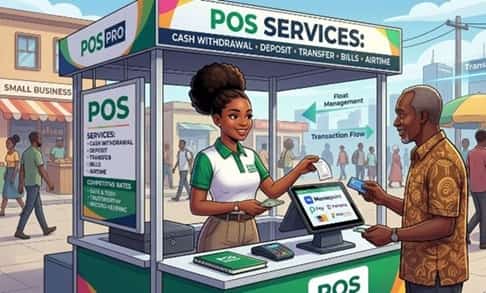
Walk through any busy street in Nigeria, and you won't go far without seeing a POS stand. They're under canopies, inside kiosks, at bus stops, inside pharmacies, everywhere. This is because the business is built on constant demand, daily cash flow, and real earning potential.
Nigerians need cash. ATMs are unreliable. Banks are far. That gap is a business, and people are making real money from it every day. By March 2025, there were 5.90 million active POS terminals deployed across Nigeria, a 119% rise from 2.69 million in March 2024. POS transactions hit ₦10.51 trillion in Q1 2025 alone. Demand isn't slowing down.With millions of Nigerians still underbanked and cash dominating everyday transactions, POS agents have carved out a profitable and essential niche.
So if you've been thinking about starting one, here's exactly how to do it.
What Is a POS Business, Actually?
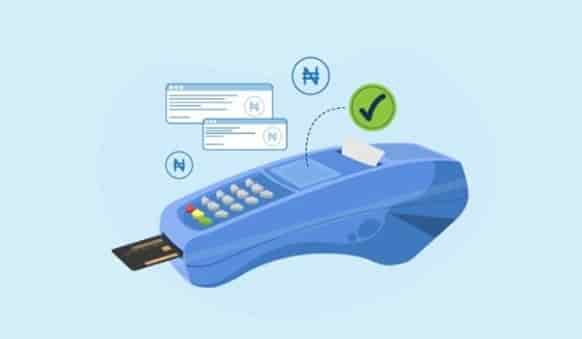
A POS (Point of Sale) business, also called agency banking, is essentially a mobile mini-bank. Using a portable card reader machine, you process financial transactions for customers in your community: cash withdrawals, transfers, bill payments, and deposits, all without them needing to visit a bank branch.
You earn a commission on every transaction. The customer pays a service charge, and you keep part of it. It’s a simple model with low capital requirements and a low barrier to entry.
It is an extension of the services offered by financial institutions.
Is It Still Worth Doing in 2026?
Short answer: Yes, if you're smart about location and operations.
The market is competitive, but the demand has also grown significantly.
Nigeria's cashless policy push (especially after the naira redesign crisis of 2023) introduced millions of previously cash-dependent Nigerians to POS agents for the first time. Many of those habits stuck. Agents who weathered that period are now running consistently profitable businesses.
Daily earnings can range from ₦5,000 to ₦50,000 depending on your location, transaction volume, and the range of services you offer. That's not guaranteed money, but in the right spot, it's consistent, not bad for a business you can run yourself.
Step 1: Understand the Business Model
Before spending a kobo, understand exactly how you'll make money.
Your income comes from transaction commissions. For every withdrawal, transfer, or bill payment, the platform takes a cut and passes a portion to you.
Typical commission rates hover around 0.5% to 1% per transaction, though it varies by provider and service type.
Let's say a customer withdraws ₦10,000 from your machine. They might pay a ₦200–₦300 service fee. You keep a portion of that. Multiply that by 50–100 transactions a day in a busy location, and the numbers start to add up.
You'll also need a float, that's the working capital sitting in your account or on hand to process transactions. If your float runs dry mid-day, you have to turn customers away. Managing your float is one of the most critical operational skills in this business.
Step 2: Register Your Business
This step is no longer optional. In May 2024, the Corporate Affairs Commission (CAC) directed all POS operators to register their businesses, either as a Business Name (sole proprietorship or partnership) or as a company. Banks and fintech platforms are increasingly requiring registration before onboarding agents.
Here's what you need to register a Business Name with the CAC:
• Two proposed business name options (for name search and reservation).
• Valid means of identification (National ID, international passport, or driver's licence).
• Residential address and contact details.
• CAC registration fee (typically ₦10,000–₦20,000+ depending on the business type).
Once registered, you'll receive a Certificate of Incorporation or Business Name Registration, which you'll need for your POS provider application. If you also need a Tax Identification Number (TIN), you can get one from FIRS; it's increasingly required for full CBN compliance as an agent. It's free, straightforward, and required once you're running a formal operation.
Step 3: Choose Your POS Provider
This is probably the most important decision you'll make. Your provider determines your machine quality, commission rates, transaction success rates, customer support, and float management tools.
Here are the major players in Nigeria right now:
- Moniepoint: The market leader by most metrics. Known for 99%+ transaction success rates and 24/7 support. Their terminals are well-regarded in the field. To get started, you'll need to fund your Moniepoint business account. They offer both machine purchase and lease options.
- OPay: One of the largest agent networks in Nigeria. You can request a mini POS machine for as low as ₦8,500–₦20,000 through the OPay app. Known for fast merchant registration and a large network.
- PalmPay: Growing fast, especially in southern Nigeria. Competitive commission structure and a user-friendly app. Worth comparing against Moniepoint and OPay.
- Firstmonie (First Bank): Good for high-volume cash transactions, highly reliable, but may have higher withdrawal charges. Better suited if you prefer the backing of a traditional bank rather than a fintech.
How to choose: Don't just go with the cheapest terminal cost. Ask other POS agents in your area which platforms have the best uptime.
As of April 1, 2026, the CBN now requires every POS agent to work with only one principal, meaning one bank, mobile money operator, microfinance bank, or licensed super-agent. The days of running multiple terminals from different providers like Moniepoint, OPay, and PalmPay simultaneously are over. Choose your provider carefully before you sign up; switching later comes with friction.
Step 4: Get the Documents Together
Whether you're applying through a bank or a fintech, you'll need most of these:
• Valid government-issued ID (National ID card, voter's card, international passport, or driver's licence).
• Bank Verification Number (BVN)
• Two recent passport photographs
• CAC Business Name or Incorporation certificate
• Proof of address (recent utility bill with your business address).
• An active bank account (personal or business) linked to your BVN.
• Two current account references (required by some banks).
Step 5: Calculate Your Startup Costs
POS business is less capital-intensive than many side hustles, but you need to be realistic about what you're starting with.
Realistically, you're looking at somewhere between ₦100,000 and ₦350,000 to get started covering your terminal, setup, CAC registration, and most importantly, your float (the cash in your account and on hand). That number shifts depending on your provider and location, but your float is the one thing you don't want to skimp on. It's what keeps the business running day to day.
If you run out of cash during a busy afternoon, you lose customers and income. Start with as much float as you can reasonably afford.
Where to get the capital:
- Personal savings (best option, no debt).
- Contribution/ajo with family or friends.
- Soft loans from microfinance banks.
- Some POS providers offer small credit facilities to agents.
Step 6: Pick Your Location (This Is Everything)
Everything in the POS business starts and ends with location. A good machine in a bad spot will fail. A basic setup in the right place will print money.
Ask any successful POS agent what made their business work, and the answer will almost always be location.
High-traffic areas that consistently perform well include:
• Markets: constant customer flow, high daily transaction volumes.
• Near bus stops and motor parks; commuters regularly need quick cash.
• School and university areas; students, parents, and staff all make regular withdrawals.
• Inside or beside filling stations, people top up cash while fuelling.
• In residential estates with no nearby bank, you become the community's bank branch
• Near churches or mosques, especially on Sundays and Fridays
Before committing to a location, spend a day observing it. How many people pass through? Are there existing POS agents?
What to avoid: Locations already saturated with 5 - 8 agents competing for the same foot traffic.
Step 7: Set Up and Launch
Once you have your machine, your registration, your float, and your location:
• Configure your terminal: Your provider will walk you through activation and linking to your settlement account
• Display your signage clearly: The services you offer as a POS agent.
• Set up a simple record-keeping system: A notebook, spreadsheet, or basic app to track daily transactions, float balance, income, and expenses.
• Inform the neighbourhood: WhatsApp Status, word of mouth, and a well-placed banner go a long way in the first few weeks.
• Keep backup SIM cards ready in case your primary network goes down mid-transaction.
Your physical setup matters more than people think. A clean, visible, organised POS point signals professionalism, and in this business, trust is what keeps customers coming back instead of walking to the next agent.
The Real Challenges
1. Network Downtime
The number one complaint from POS agents. Transactions hang, decline after debiting the customer, or fail. This is where your provider choice matters most.
Have multiple SIM cards and know which network works best in your area. Be transparent with customers, "the network is slow, give me two minutes" goes a long way.
2. Float Management
Running out of float is a silent business killer. You turn away customers, lose their trust, and they walk to your competitor. Monitor your float balance consistently and top it up before it runs low, not after.
3. Security
You're handling cash, which makes you a target. Operate in visible, populated areas. Be discreet when counting or storing money, don't flash cash. Keep a lockbox on site, but don't let large amounts pile up. And be cautious with very large transactions from people you don't know.
4. Fraud
Fraudsters test POS agents with fake alerts, reverse transaction tricks, and social engineering. Learn common POS fraud patterns before you start. Always wait for transaction confirmations before releasing cash. Never release funds based on a screenshot.
5. Competition
If you're in a busy area, there will be other agents nearby. Your edge is reliability, customer service, and reasonable fees.
Failed transactions: Keep a record of every failed transaction with timestamps. Report to your provider immediately. Most resolve within 24–48 hours.
Bottom Line
The POS business is one of the most genuinely accessible businesses in Nigeria right now. It's a business that requires a good location, proper float management, and consistent customer service. It is one of the few businesses in Nigeria where the fundamentals are genuinely in your favour.
Underbanked population? Check.
ATM frustration? Check.
Cash economy? Very much still checked.
Start small. Test the location. Learn the patterns. Then scale.
Keep reading
Related Topics




Conversation
Comments (0)
Sign in to join the conversation or like this post.

Elizabeth Ayoola
Elizabeth is a finance analyst and writer passionate about making financial markets accessible to everyday readers.
She has a deep interest in global markets, crypto, and everything shaping the financial world. She writes to simplify complex financial topics, turning them into practical, accessible insights for everyday readers.
102
Stories
31719
Reads
1
Likes
0
Comments