
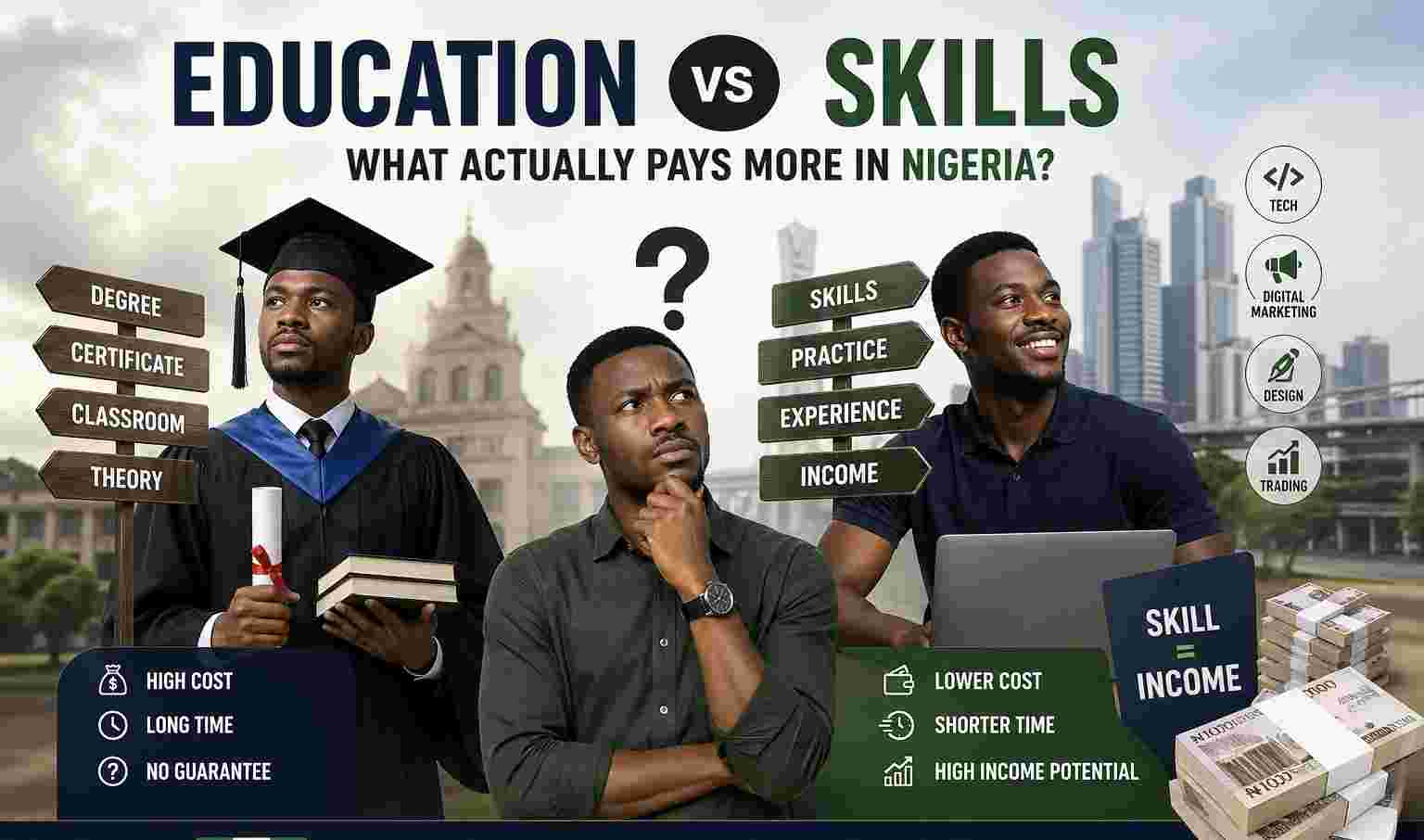
For a long time, education was seen as the sure path to a good life in Nigeria. The belief was simple: go to school, get a degree, and a stable job will follow.But today, that story feels different for many people.
You’ll find graduates searching for jobs for months or even years. At the same time, people with practical skills are earning daily, building small businesses, and even supporting themselves without waiting for formal employment.
This has created a growing debate: is education still enough, or are skills now more important for survival and income?
The truth is not black and white. Nigeria’s economy, job market pressure, and population growth have changed how opportunity works.Let’s break it down honestly.
Education Still Matters,That Has Not Changed
Before anything else, it is important to say this clearly: education is still valuable.
Formal education gives structure, discipline, and access to certain careers that skills alone cannot replace. You still need education to become a doctor, lawyer, engineer, pharmacist, or work in many government and corporate roles.
It also teaches communication, critical thinking, and exposure to knowledge that is useful beyond the classroom.
So education is not useless. In fact, it is still a foundation for many people’s careers.
The issue is not education itself,it is what happens after education in today’s economy.
The Reality of Nigeria’s Job Market
This is where things become more complicated.
Nigeria has a growing number of graduates every year, but the number of available formal jobs is not growing at the same pace. This creates heavy competition in the job market.
What this means in reality is:
• Many qualified people are applying for the same roles
• Employers often receive hundreds or thousands of applications for a single position
• Getting jobs is not just about qualifications anymore
• Sometimes, connections or referrals influence who gets selected
It is not always fair, and it is not always official,but it is the reality many people experience.
Even people with good degrees often find themselves waiting longer than expected before getting their “dream job.”
Why Skills Are Becoming More Important
In contrast to formal jobs, skills offer something different: direct access to income without waiting for employment.
A skill allows you to solve a problem and get paid immediately.
For example:
• A graphic designer can work with clients online or locally
• A tailor can get daily or weekly customers
• A social media manager can handle pages for small businesses
• A phone repairer earns from fixing real problems
These people don’t need to wait for HR interviews or job postings. Their income depends on demand for what they can do.
That is why skills are becoming more attractive, especially for young people.
Why Some Educated People Still Struggle
It is important not to generalize, but many educated people still face challenges because:
• Job opportunities are limited compared to the number of graduates
• Some degrees are not directly connected to practical work
• Many people finish school without learning any income-generating skill
• Experience is often required even for entry-level jobs
So even though education is important, it does not automatically guarantee financial stability in today’s environment.
This is not a failure of education itself,it is a mismatch between schooling and Nigeria’s economic reality.
Skills Do Not Replace Education,They Complement It
A common mistake in this debate is thinking it has to be one or the other.In reality, the strongest position is having both.
Education helps you understand structure and communicate professionally. Skills help you earn money and stay flexible.
For example:
• A graduate who learns digital marketing can get remote or freelance work
• An accounting student who learns Excel and financial tools becomes more employable
• A mass communication graduate with video editing skills can work in media or content creation
When education and skills work together, opportunities increase significantly.
The New Reality: Income Follows Value, Not Just Certificates
One major shift in today’s economy is this: people are paid more for what they can do, not just what they studied.
Employers, clients, and customers now focus more on results.
That means:
• Can you design?
• Can you write?
• Can you sell?
• Can you solve a problem?
This is why some people without degrees are earning well, while some graduates are still searching.
It is not about intelligence,it is about market relevance.
Skills That Are Working in Nigeria Today
Some skills are currently more visible in terms of income opportunities:
• Digital marketing and social media management
• Graphic design and branding
• Video editing and content creation
• Copywriting and freelance writing
• Tech skills like coding and UI/UX design
• Hairdressing, tailoring, and beauty services
• Plumbing, electrical work, and repairs
• Food and baking businesses
These skills are not “better” than education,they are simply more directly connected to daily demand.
A Balanced Truth: What Actually Pays More?
If we are being completely honest, skills often pay faster.Education pays slower but offers structure and long-term stability in formal careers.
So the real answer is:
Skills bring faster income opportunities. Education builds long-term professional access.
But in Nigeria today, because of job scarcity and competition, skills are often what help people start earning earlier.
The Smart Approach in Today’s Nigeria
Instead of choosing sides, the smarter approach is combining both.
Think of education as your base, and skills as your tool.One gives you direction. The other gives you income.
People who understand this balance are the ones adapting better to today’s economy.
Final Thoughts
The debate between education and skills is not about replacing one with the other.
Education still matters deeply,it shapes knowledge, discipline, and access to certain professions.
But Nigeria’s current reality has made skills equally important because they offer faster and more flexible ways to earn.
In a job market where opportunities are limited and competition is high, what you can do often matters as much as what you studied.
The most secure position today is not choosing one,it is building both.
Keep reading
Related Topics

Conversation
Comments (0)
Sign in to join the conversation or like this post.

Maramercii
Maramercii contributes reporting and analysis for NaijUp, covering the stories, markets, and business trends shaping Nigeria.
67
Stories
35071
Reads
0
Likes
0
Comments