
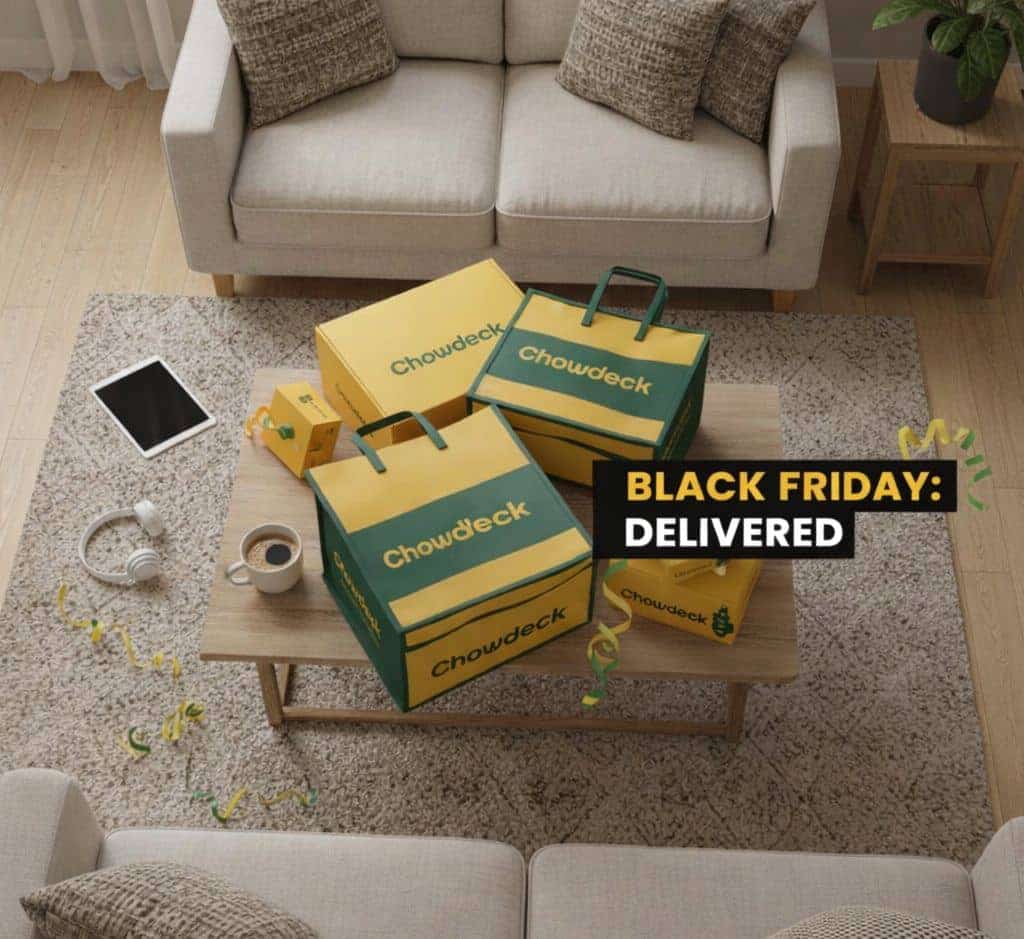
Nigeria’s Black Friday used to mean crowded malls, endless queues, and flash sales on fashion and electronics. This year, food won.
During Chowdeck's Big Black Friday weekend (from Friday, November 28 to Monday, December 1, 2025), vendors on Chowdeck processed ₦1.4 billion worth of orders, completing 183,000+ deliveries across Lagos, Abuja, Ibadan, and parts of Ghana. On Friday alone, the platform recorded 52,000+ orders, its highest single-day volume ever. At peak hours, Chowdeck was processing 115 orders per minute, sustaining 5,000+ orders per hour for five straight hours.
Food delivery didn’t just participate in Black Friday. It dominated it.
Turning Black Friday Into a Live Event
Instead of a typical promo-heavy sales weekend, Chowdeck turned Black Friday into a live experience.
For the first time, the company launched a BFCM live tracker, a public dashboard that allowed anyone to watch the entire operation unfold in real time. The tracker displayed:
• Live app visits
• Orders rolling in across cities.
• Total transaction value climbing by the second.
• Kilometers covered by riders.
• Fastest delivery times.
Then came the twist.
A small puzzle was embedded in the tracker.
No prizes. No discounts. Just curiosity.
That single detail changed everything. What could have been passive viewing turned into competition. Customers weren’t just watching orders fly in; they were racing to crack the puzzle. One person solved it in under six seconds. The result? 2.5 million app visits over the weekend.
This wasn’t marketing fluff. It was engagement engineering.
A Record Weekend for Vendors and Riders
Behind the dashboard were real businesses and real livelihoods moving at full throttle.
Restaurant partners like Chicken Republic, alongside hundreds of local vendors, processed thousands of orders throughout the weekend. For many, it was their highest single-day sales ever on the platform.
Riders were equally busy:
• 727,000+ kilometers covered
• One rider earning ₦205,000 in a single weekend.
• Fastest recorded delivery: 1 minute 30 seconds.
This wasn’t just demand; it was demand met efficiently, powered by a logistics engine that scaled under pressure.
Black Friday, By the Numbers
- ₦1.4 billion total transaction volume
- 183,000+ orders delivered
- 52,000+ orders on Friday alone
- Peak: 115 orders/minute; 5,000+ orders/hour for five consecutive hours.
- 2.5 million app visits
Sales volume more than doubled compared to Chowdeck’s Black Friday performance in 2024.
Built for Scale, Not Hype
This breakout moment didn’t happen by accident.
Founded in October 2021, Chowdeck has quietly built one of Africa’s most efficient on-demand delivery systems. Today, the platform serves:
• 1.5 million customers
• 20,000+ riders
• Operations across 11 cities in Nigeria and Ghana.
• An average delivery time of 30 minutes.
In 2024, the value of meals delivered through Chowdeck increased by more than sixfold year-over-year. In 2025, the company surpassed its entire transaction volume for 2024 by July.
Backed to Go Further
Chowdeck has raised $18.4 million across multiple funding rounds, including:
- $2.5 million seed, backed by Y Combinator, Goodwater Capital, and Paystack co-founders.
- $9 million Series A, led by Novastar Ventures.
The capital is used to:
1. Roll out quick commerce powered by dark stores.
2. Expand into more cities across Nigeria and Ghana.
3. Reduce delivery times even further.
4. Scale groceries and essentials delivery.
5. Build deeper software tools for vendors.
The recent acquisition of Mira, a POS company for food and hospitality businesses, positions Chowdeck as more than a delivery app, a SaaS-plus-logistics partner for restaurants.
Why This Moment Matters
Chowdeck’s Big Black Friday wasn’t just about big numbers. It was a signal.
Nigeria’s digital economy is shifting fast. Traffic congestion, rising smartphone adoption, improved payment infrastructure, and changing consumer habits are pushing everyday commerce online.
Food delivery is no longer a convenience. It is infrastructure.
As CEO, Femi Aluko has noted, “The market is still very early. A whole generation is growing up ordering food without ever stepping into some of the restaurants on our platform.”
Keep reading
Related Topics





Conversation
Comments (0)
Sign in to join the conversation or like this post.